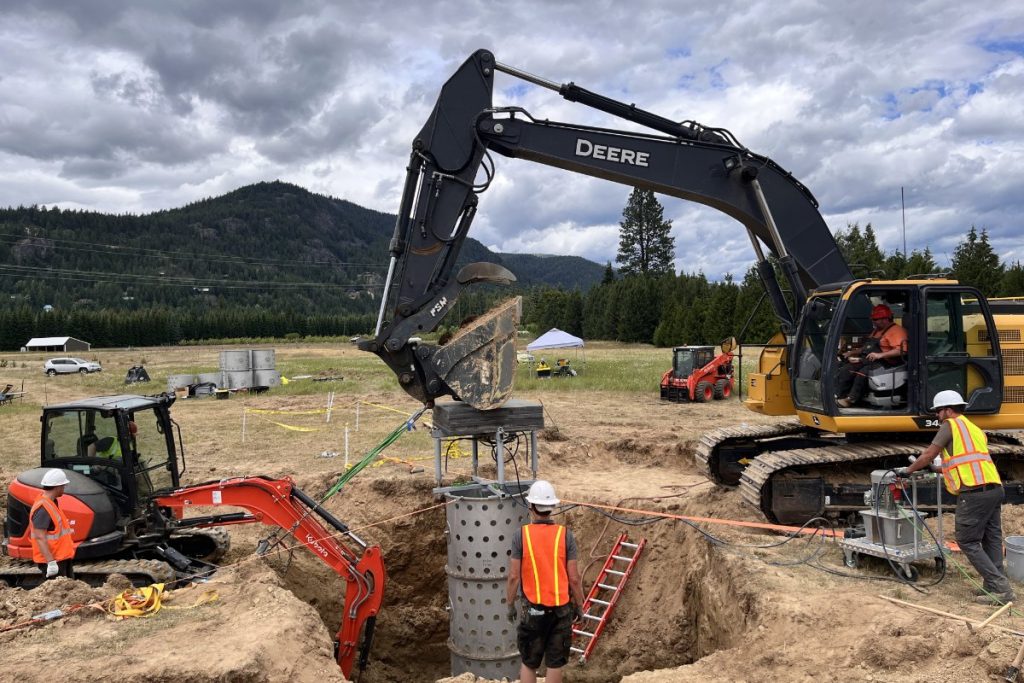
At the Sandpoint Organic Agriculture Center in Northern Idaho, a hydraulic press pushes a massive, hollow stainless steel cylinder, 4 feet across and 10 feet long, deep into the ground. An excavation crew constantly removes surrounding soil so the cylinder can continue to its slow descent. Four feet down it goes, then 6 feet, then
At the Sandpoint Organic Agriculture Center in Northern Idaho, a hydraulic press pushes a massive, hollow stainless steel cylinder, 4 feet across and 10 feet long, deep into the ground. An excavation crew constantly removes surrounding soil so the cylinder can continue to its slow descent. Four feet down it goes, then 6 feet, then 7, enclosing soils that are thousands of years old, dating to epochs of volcanic eruption and glacial retreat.
Michael Strickland is no stranger to such unearthings. A microbial ecologist, he often goes into the field to collect soil samples, or cores, to study in the lab. Usually, he’s probing to a depth of about a foot. This dig will go 10 times deeper.
As the press nears the 8-foot mark, the soil layer, which is likely near 10,000 years old, is heavily compacted and does not budge. Watching nearby, Strickland catches his breath as the machine grinds to a halt. “I’m thinking, ‘Is it going to happen? Are we going to get this core out of here?’” he says. The work slows to a creep, but with some coaxing, the land opens up centimeter by labored centimeter.
This new research facility provides a rare chance to study deep soils, largely uncharted domains that are at once remnants of the past and potential harbingers of the future.
Over the course of three weeks, the process continues until finally, six soil-filled cylinders are ready to be capped, strapped onto a truck, and driven to their new home: The University of Idaho’s Deep Soil Ecotron, where Strickland is the director.
This new research facility, opened in May 2025, provides a rare chance to study deep soils—largely uncharted domains that are at once remnants of the past and potential harbingers of the future for agriculture and climate science.

At the Deep Soil Ecotron excavation site, a hydraulic press pushes a lysimeter deeper into the ground. The crew constantly clears soil from the base of the column as it descends. (Photo courtesy of University of Idaho)
Why Study Deep Soils?
Most soil research focuses on topsoils, which reach an average depth of 27 centimeters (about 10 inches). This surface-level focus is partially a matter of logistics: Taking intact soil cores from deep underground is time-consuming, challenging work that requires special machinery.
Scientists have paid less attention to deep soils for another reason: They’re relatively stable. Deep soils start roughly 30 centimeters (about a foot) below the surface and are lower in oxygen than topsoil, limiting their microbial turnover, gas exchange, and plant activity. Topsoils, which are constantly shifting in response to environmental conditions, offer a more dynamic field of study.
In the last few years, however, emerging research has suggested that the hidden realms of deep soils are worth exploring. Deep soils, for example, could play an important role in climate change mitigation by storing carbon deep underground. While carbon sequestered in topsoil—once hailed as a solution to the climate crisis—is anything but permanent, carbon at deeper depths appears to be more stable and protected. Beyond their carbon-sequestering capacity, the way that deep soils cycle and store other compounds, like nitrogen and water, could prove relevant to farmers looking to maximize yields.
Deep soil has been compared to outer space and the depths of the ocean: a “dark forest” that is mysterious and relatively unchartered.
Deep soil also seems to be teeming with novel bacteria that don’t exist anywhere else, and could be just as rich in microbial life as surface soil. The intact soil cores collected here will give Strickland and his team a glimpse into what types of organisms have adapted to these dark, dense, low-oxygen environments, and how they impact the wider ecosystem.
“The interaction between roots, minerals, and microbes going beyond the topsoil is really fascinating and can help us better understand the soil, our climate, and how changing conditions above ground are driving dynamics below ground,” says Ashley Keiser, a DSE science advisor and soil ecologist at UMass Amherst.
Deep soil has been compared to outer space and the depths of the ocean: a “dark forest” that is mysterious and relatively unchartered. The new Idaho facility offers a look into an otherwise unseen world—and the possibilities that come with it.
A New Type of Laboratory
Ecotrons exist all over the world, but are relatively new. They realistically simulate natural ecosystems in a controlled environment and allow researchers to monitor how atmosphere, soil, and plants interact as the conditions around them change.

A soil pit at Sandpoint Organic Agriculture Center after a Deep Soil Ecotron excavation exposes the levels of deep soil. (Photo credit: Michael Strickland)
Since the first ecotron facility opened at Imperial College London in the early 1990s, about a dozen others have been built, mostly in Europe. Many of these facilities research how climate changes affect the functioning of different ecosystems, from heathlands to freshwater ponds.
Idaho’s Deep Soil Ecotron (DSE) is the first in the world dedicated to deep soils. The DSE, mostly funded by a $18.95 million grant from the U.S. National Science Foundation, houses 24 of the gigantic columns. Six are filled; the remainder will house soil from Idaho and beyond.
These “ecounits” are notable not only for their size and depth, but also for their scientific controls. They are equipped with heat exchangers for adjusting soil temperature and ceramic suction cups for modifying water content. Scientists can also tinker with the light, humidity, and greenhouse gas (methane, carbon dioxide, and nitrous oxide) concentrations at the surface of each unit. “We can essentially mimic almost any climate conditions, barring extreme cold,” says Strickland. At the top of each soil column rests a “grow chamber” where researchers can interact with the topsoil, growing crops or applying soil amendments depending on what they’re studying.
Sensors are installed throughout each column to deliver continuous information about how the soil is responding to the changes happening below and above the surface.
All six of the filled columns contain soil from the Sandpoint site. Three have intact soil cores that were extracted with the hydraulic press and represent natural, untouched soil environments. The other three have “disturbed” soils that were filled manually and exposed to oxygen, likely affecting their structure and function. These different sample types are now undergoing data collection and proof-of-concept work before the facility opens up to the broader scientific community in the next six to 12 months.
Deep Soil’s Potential for Farmers
Robert Blair is a farmer and University of Idaho alum who grows wheat, barley, lentils, chickpeas, and alfalfa on 800 acres in Kendrick, Idaho. Like many producers across the country, he is struggling to maintain profits amid increasingly high production costs and volatile tariffs on commodity crops. He grows without irrigation, which also leaves him at the mercy of often unpredictable rain and snowfall.

At the Deep Soil Ecotron, a soil cylinder equipped with sensors that monitor soil conditions like temperature and moisture content. (Photo credit: Michael Strickland)
Once he learned about the DSE through his role on a university advisory board, he started digging into ways it could help him prepare for and respond to unpredictable weather events like drought so they wouldn’t hurt his yields and margins as much.
“This [facility] can allow us to simulate different climatic events—from a really wet year to a drought year—not only in the top at the grow chamber, where the crop is, but throughout that soil profile,” Blair says. “Once we know what the moisture levels are 2 feet, 3 feet, 10 feet down, we as farmers may be able to better manage our crops based upon those findings.”
















Leave a Comment
Your email address will not be published. Required fields are marked with *