These lands are part of the 80 percent of Alaska that sits in a zone containing permafrost—ground that remains at or below 32 degrees Fahrenheit for two or more consecutive years. The thawing of this layer can trigger a process called subsidence, a physical sinking of the land ranging from a few inches to more
These lands are part of the 80 percent of Alaska that sits in a zone containing permafrost—ground that remains at or below 32 degrees Fahrenheit for two or more consecutive years. The thawing of this layer can trigger a process called subsidence, a physical sinking of the land ranging from a few inches to more than three feet deep. In addition to damaging buildings and infrastructure, subsidence impacts soil fertility and waterflows, and releases ancient stores of carbon into the atmosphere, heating it and exacerbating the thawing.
With the Arctic warming two to four times faster than the global average, permafrost thaw is becoming increasingly prevalent—and is expected to accelerate. Increasing temperatures and precipitation, as well as wildfires, drive the thawing; so does clearing land for agriculture, which removes protective and insulating vegetation.
Because the frozen layer lies beneath the “active layer” of soil that thaws annually and can be used to grow crops, farmers don’t necessarily know if their land contains permafrost until they see the signs of its degradation: mysterious crop loss, damaged farming equipment, or ground that sinks gradually over time.
Permafrost Grown, based in Fairbanks, equips local farmers with tools that make it easier to manage permafrost land. The five-year, $3 million project, launched in 2022 and funded by the National Science Foundation’s Navigating the New Arctic Initiative, is a collaboration between researchers and producers that studies how certain agricultural practices impact permafrost degradation.
The findings of the project, now in its final year, could prove important for people outside the 49th state, too. Climate change could make farming at warmer, lower-latitude regions more difficult and push agriculture further north in the coming decades. Because its thawing drives climate change, permafrost also has important climate implications on a global scale.
We connected with Melissa Ward Jones, a permafrost geomorphologist and the principal investigator of the Permafrost Grown project, and Glenna Gannon, a sustainable food systems researcher and the project’s co-investigator, to learn more about the permafrost-agriculture intersection and its relevance to farming and food production in Alaska and beyond.

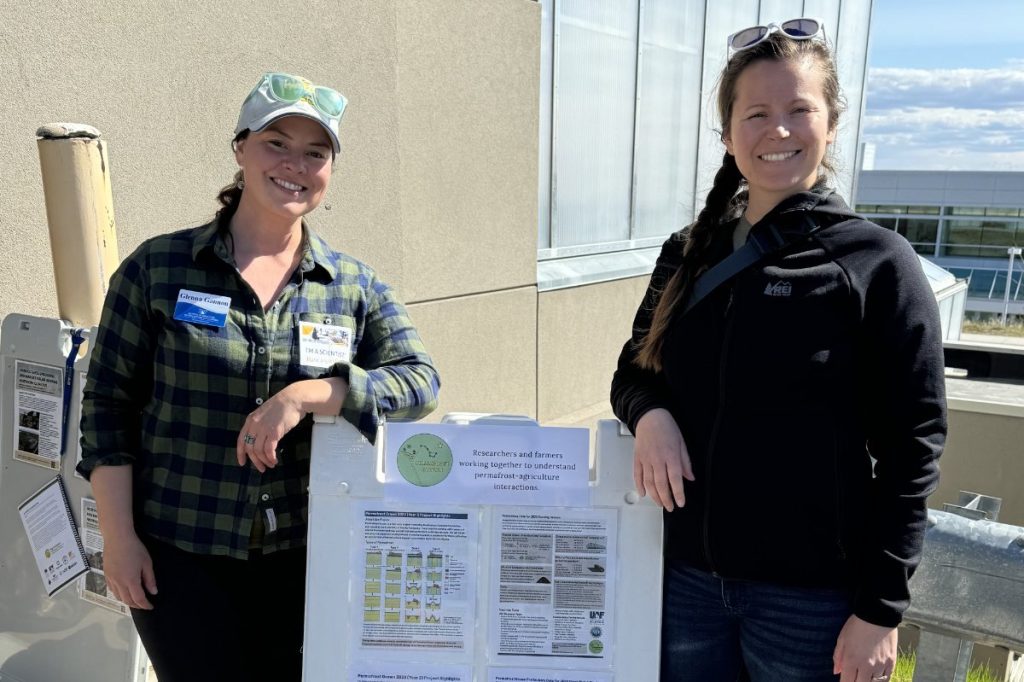
Glenna Gannon (left) and Melissa Ward Jones (right) at the University of Alaska Fairbanks Arctic Research Open House with a display of Permafrost Grown handouts. (Photo credit: Laura Weingartner)
What are some of the ways you’ve seen permafrost thaw negatively impact farms in your region?
Glenna Gannon: Some of the earliest questions folks were asking us were about obvious subsidence—areas where the ground has depressions. That could look like anything from the ground sinking to tractors getting stuck and not being able to work the land in that particular area. There’s one peony producer we work with who abandoned their farm field [due to subsidence].
Melissa Ward Jones: There can be a lot of stress and uncertainty when parts of your land are continuously sinking and you don’t know what is causing it, exactly, but you know it’s related to permafrost. The sinking can kill crops, inhibit you from planting the crops you want to plant, and damage farm equipment and fencing.
Subsidence can also impact soil fertility. And groundwater cannot flow through frozen soil, so as it thaws, it also changes groundwater flow patterns.
Are there any protections in place for farmers whose land subsides due to permafrost thaw?
GG: Currently, there’s nothing at the state or federal level, or private agricultural crop insurance, that covers permafrost. Traditional agricultural insurance is designed for “probabilistic” events like hailstorms and drought.
Let’s dig into Permafrost Grown’s model of a diverse research team collaborating with farmers to conceptualize and implement studies. Why was taking this approach important to you?
MWJ: Permafrost Grown focuses on such a big topic that it needed a range of experts from a range of research disciplines as well as collaborator farms that represent a range of cultivation activities and permafrost types.
I think everyone’s background and expertise strengthens the overall project. Glenna was a great fit with her expertise of agriculture and food system sciences and her network of farms. Permafrost science is a broad discipline, and the co-investigators expanded our permafrost expertise: Dr. Mikhail Kanevskiy is an expert in cryostratigraphy, the analysis of permafrost cores. Dr. Benjamin Jones is leading the permafrost drilling, remote sensing, and drone-mapping work. And Dr. Tobias Schwoerer is a natural resource economist who provides expertise in economics and people’s perceptions of risk and decision-making strategies.
How do you choose which types of farms to work with?
GG: We started the project with a smallish cohort of farmers who we already knew were experiencing some challenges associated with permafrost on their farms. As we developed the project, we identified a few more. And then, by year two of the project, there were a couple of farmers who were saying, “I heard about your work. I’d love to be involved,” or “I’ve got this crazy thing going on. Could you guys help?”
We tried to be mindful of folks who had different types of agricultural operations—vegetable crops, grains, or hay, or animal production—as well as the types of permafrost or symptoms of agriculture-permafrost interactions, so that we had a gamut to look at and collect data from.
We currently have 10 collaborating farms in Alaska; nine are in the Greater Fairbanks Region of the Tanana Valley.
You have a number of studies underway, on subjects like how compost and different types of mulches impact land that has permafrost. How do you collaborate with farmers to design and implement this research?
MWJ: Throughout the year, we maintain constant communication. We share an annual survey that asks how their year went and [includes] questions that help us plan for upcoming trials or data collection. We [also] have workshops where we discuss as a group.
GG: We’re also doing farm visits. What’s a bit more unique about this work is that since we live in the same community [as the farmers], we’re not just meeting in an office building once a year. We’re visiting these people at their homes. Melissa’s daughter plays with some of these folks’ kids. We see these individuals in our community. So there is definitely a very local perspective and feeling to this project.
Despite the challenges of things like permafrost and living in the subarctic region, a lot of the farmers have a built-in purpose for doing this work and an attitude of resilience, which is really profoundly positive to work with.

Melissa Ward Jones, principal investigator of the Permafrost Grown project, leads a tour with team members and producers of the Cold Regions Research and Engineering Laboratory Permafrost Research Tunnel in Fox, Alaska. A cross section of a massive ground-ice body stretches down the tunnel’s right wall. (Photo credit: Laura Weingartner)
What is an example of a specific permafrost-agriculture interaction you’re researching?
MWJ: With our Great Mulch Study, we’re looking at the thermal impact of 11 different mulch types, including straw, paper, and soy-based plastic products, as well as a few synthetic mulches like infrared-transmitting (ITR) plastic mulch.
We’re interested in seeing if some are better suited to potentially mitigate permafrost thaw and identify others that could accelerate permafrost thaw.
GG: And we’re evaluating these different mulches for their intended agricultural use too—looking at weed suppression, moisture retention, and soil warming.
MWJ: [Mulch] is one of the topics of our projects that farmers want to talk to us about the most. Even if you’re not looking at it from a permafrost perspective, it’s still beneficial for agriculture in Alaska more generally to have this kind of data, because this research has just not been done at high latitudes. We’re the only ones to our knowledge who are doing it at this scale.
What does this data collection look like in practice?
GG: Melissa and I have a full replicated trial with all treatments at the Agriculture and Forestry Experiment Station in Fairbanks. Some of our partner farms are replicating some of the specific mulch treatments [on their fields]. So that might be one or two of the mulch types with one or two crop types.
No farmer is going to give up a huge portion of their field to set up an experiment when they’re trying to make a living. So we work with folks as best as we can to say, “What’s meaningful to you and not going to disrupt your personal economy?”













Leave a Comment
Your email address will not be published. Required fields are marked with *