Why Are Rubber Plant Leaves Falling Off? Rubber plant leaves fall off mainly due to overwatering, underwatering, low light, or sudden environmental changes like moving or temperature drops. Overwatering is the most common cause and can lead to root rot. Identifying the exact reason depends on soil moisture, leaf texture, and any recent changes in the
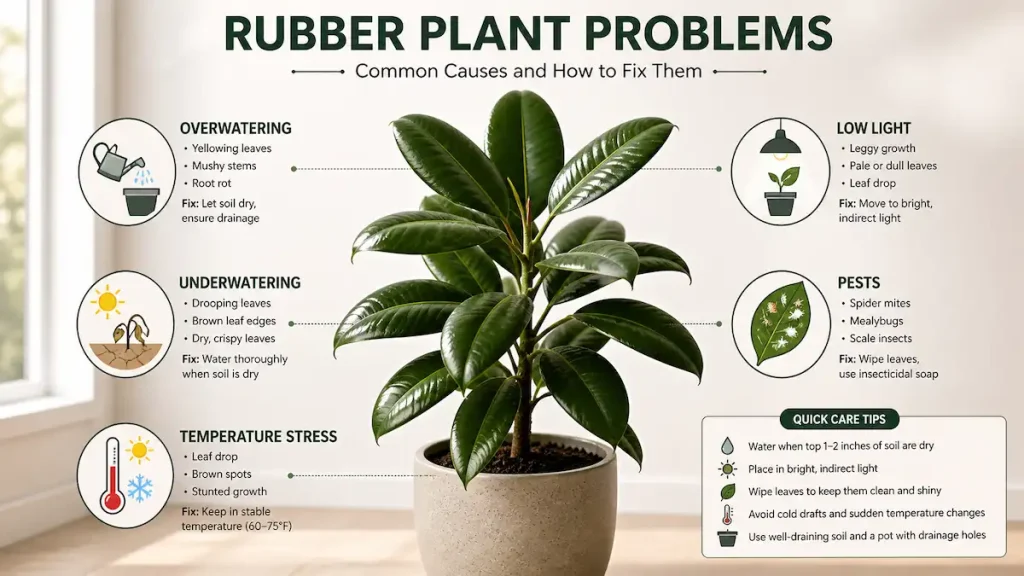
Why Are Rubber Plant Leaves Falling Off? Rubber plant leaves fall off mainly due to overwatering, underwatering, low light, or sudden environmental changes like moving or temperature drops. Overwatering is the most common cause and can lead to root rot. Identifying the exact reason depends on soil moisture, leaf texture, and any recent changes in the plant’s environment.
You walk past your rubber plant and notice another leaf on the floor. Then another. Then the remaining leaves start curling at the edges and you start wondering if you’re slowly killing it. Sound familiar?
The good news — rubber plant leaves falling off is one of the most common houseplant complaints, and in almost every case it’s fixable once you know what’s behind it. Whether your rubber plant is dropping leaves suddenly, losing leaves from the bottom, or shedding them with a curl and a color change, this guide covers every real cause — from overwatering and poor light to repotting shock and move stress — with a clear fix for each. If your rubber plant leaves are falling off and you’re not sure where to start, the 1-minute root cause test below will point you in the right direction.
Is It Normal for a Rubber Plant to Lose Leaves?
Short answer: Yes — in small amounts. Rubber plants naturally shed older lower leaves as they grow, and dropping one or two in autumn or winter is expected. It becomes a problem when multiple leaves fall at once, when leaves drop from the middle or top of the plant, or when yellowing, curling, or wilting appear alongside the leaf loss.
Seasonal changes matter too. In autumn and winter, indoor light levels drop noticeably, and rubber plants often respond by shedding a leaf or two. That’s expected — not a sign something’s wrong.
When to worry: Multiple leaves dropping at once, leaves falling from the middle or top of the plant, leaves curling before dropping, or any combination of yellowing, browning, or wilting alongside the leaf loss.
How to Diagnose Why Your Rubber Plant Is Dropping Leaves
Before jumping to solutions, look closely at the leaves that are falling and those still on the plant. The symptoms tell you almost everything you need to know.
Look at the Leaves Before They Fall
- Yellow, soft, mushy leaves → overwatering or root rot
- Dry, crispy edges with inward curl → underwatering or low humidity
- Healthy-looking leaves that still drop → environmental stress, move shock, or temperature change
- Pale, washed-out color before dropping → insufficient light
- Sticky residue or tiny bugs visible → pest infestation
Quick Diagnosis Table
| Symptom | Likely Cause | Urgency |
|---|---|---|
| Yellow, soft leaves | Overwatering / root rot | High |
| Dry, curling edges | Underwatering | Medium |
| Sudden mass leaf drop | Relocation / move stress | Medium |
| Pale, drooping leaves | Low light | Low–Medium |
| Leaf drop after repotting | Transplant shock | Low |
| Sticky residue + drop | Pests | Medium–High |
| Brown tips + curl | Low humidity or tap water | Low–Medium |
Rubber Plant Leaf Drop Timeline — Fast Diagnosis by Day
Not sure how long the problem has been building? When symptoms first appear tells you almost as much as what they look like. Use this timeline as a fast shortcut to narrow down the cause before reading further.
| Timeframe | What You’re Seeing | Most Likely Cause |
|---|---|---|
| Day 1–3 | Sudden leaf drop with no warning, otherwise healthy-looking | Move shock or temperature stress |
| Day 4–7 | Leaves curling inward + soil bone dry | Underwatering |
| Day 7–14 | Yellow, soft leaves dropping, soil wet or slow to dry | Overwatering / root rot developing |
| 2–3 weeks | Slow, steady leaf drop + pale, washed-out color | Low light |
| Within 2–4 weeks of repotting | Leaf drop, but plant otherwise looks okay | Transplant shock |
1-Minute Root Cause Test — No Guesswork
Follow these four steps in order. In under 60 seconds you can identify the exact cause of your rubber plant’s leaf drop with 90% accuracy — no tools needed.
- Touch the soil — Wet or soggy → overwatering. Bone dry → underwatering. Moist and normal → move to step 2.
- Check the leaf texture — Soft and yellow → overwatering. Dry and crispy → underwatering. Firm but still dropping → step 3.
- Think about recent changes — Did you move the plant? → relocation stress. Did you repot it? → transplant shock. Neither? → step 4.
- Check the light — Is the plant more than 4–5 feet from a window, or in a room with little natural light? → low light is the likely culprit.
If you get through all four steps and nothing fits, check for pests (fine webbing, sticky residue, tiny bugs on leaf undersides) or consider tap water quality and fertilizer overuse as secondary causes.
Rubber Plant Leaves Falling Off Due to Overwatering

Wet roots are a rubber plant’s worst enemy. Overwatering is the single most common cause of leaf drop and curling in rubber plants — and it’s behind more rubber plant deaths than anything else.
Signs Your Rubber Plant Is Overwatered
- Leaves turn yellow, starting from the lower leaves
- Leaves feel soft or limp rather than firm and glossy
- Soil stays wet for more than 10 days
- Musty smell from the soil — a sign of root rot developing
- Stem base feels soft or spongy
How to Fix an Overwatered Rubber Plant
- Stop watering immediately and let the soil dry out completely before the next water
- Check the roots — tip the plant out and look for dark, mushy roots (healthy roots are white or tan)
- If root rot is present, trim the affected roots with clean scissors, dust with cinnamon (a natural antifungal), and repot into fresh, well-draining soil
- Ensure your pot has drainage holes — a pot without drainage is a slow death sentence for rubber plants
- Going forward: water only when the top 1–2 inches of soil are dry to the touch — roughly every 1–2 weeks in summer, every 3–4 weeks in winter
Soil matters here too. A chunky, well-draining mix — standard potting soil blended with perlite and a little bark — lets water pass through rather than pool around the roots. Dense, compact soil causes root rot even if your watering timing is otherwise spot on.

Rubber Plant Leaves Falling Off and Curling From Underwatering

Underwatering is less common than overwatering but still worth ruling out — especially in warm rooms, during summer, or if you’ve been away for a week or two. An underwatered rubber plant drops leaves too, usually green or slightly brown ones that feel dry and papery, not soft.
Signs of an Underwatered Rubber Plant
- Rubber plant leaves curling inward or upward at the edges — one of the clearest signs of thirst
- Leaves feel dry and slightly brittle before dropping
- Soil is bone dry, pulling away from the edges of the pot
- Leaves may still be green but look dull and lifeless
How to Fix Underwatering
- Confirm with the soil test — push a finger 2 inches in. If it’s completely dry all the way down, underwatering is confirmed
- Bottom water first — sit the pot in a tray of water for 20–30 minutes so the soil absorbs moisture evenly from below, then top water until it drains freely from the holes
- Reassess your schedule — check soil every 5–7 days going forward and water based on dryness, not a fixed calendar. Adjust for season and room temperature
According to Clemson University’s Home and Garden Information Center, rubber plants perform best when allowed to dry out slightly between waterings — consistent moisture without prolonged drought or waterlogging is the goal.
Overwatering vs. Underwatering — How to Tell the Difference
These two problems can look deceptively similar on the surface. Here’s how to tell them apart quickly and accurately.
| Factor | Overwatering | Underwatering |
|---|---|---|
| Leaf color | Yellow, pale | Green or brown-edged |
| Leaf texture | Soft, limp | Dry, crispy |
| Soil feel | Wet, compacted, possibly smelly | Bone dry, shrinking from pot edges |
| Curl direction | Downward droop | Inward or upward curl |
| Fix | Dry out, possibly repot | Deep watering, consistent schedule |
Rubber Plant Leaves Falling Off in Low Light Conditions
Rubber plants are often marketed as low-light houseplants. That’s not quite right. They can tolerate lower light for a while, but they genuinely need bright, indirect light to stay healthy. Put one in a dim corner and it’ll steadily drop leaves as it struggles to sustain itself.

How Much Light Does a Rubber Plant Need?
Aim for 6–8 hours of bright, indirect light daily. Direct harsh sun can scorch the leaves, but bright filtered light near a window is ideal. East or west-facing windows usually work well. South-facing with a sheer curtain is excellent.
How to Fix a Light-Starved Rubber Plant
- Move the plant closer to a window — even 2–3 feet can make a significant difference
- Rotate the pot 90 degrees every 2 weeks for even light exposure
- If natural light is limited (apartment with small windows), a grow light on a timer for 10–12 hours a day works well
Rubber Plant Leaves Falling Off Due to Temperature Stress and Cold Drafts
Rubber plants are tropical by origin and like warmth and consistency. Temperatures below 50°F (10°C) can trigger rapid leaf drop, and even a cold draft from a nearby window or AC vent is enough to start the shedding. The ideal range is 60–85°F (15–29°C). Keep them away from drafty windows in winter, AC vents, and dry heating radiators. A useful check: if a spot feels uncomfortable to sit in — too cold, too breezy — it’s not suitable for your rubber plant either.
Why Rubber Plant Leaves Are Falling Off After Repotting
Repotted your rubber plant recently and now it’s dropping leaves? That’s repotting shock — very common and usually temporary. Root disturbance, fresh soil, and a new container all hit the plant at once, and leaf drop is its way of shedding stress while it re-establishes.
How to Minimize Transplant Shock
- Repot only when the plant is genuinely root-bound (roots circling the base or poking out of drainage holes)
- Choose a pot only 1–2 inches larger than the current one — too large a pot holds excess moisture
- Keep the same soil level as before — burying the stem higher can cause rot
- Water lightly after repotting, then leave it alone for a week or two
- Avoid fertilizing for at least 4–6 weeks after repotting — roots are sensitive
Expect some leaf drop in the first 2–4 weeks after repotting. As long as new growth appears within 4–6 weeks, the plant is adjusting fine.
Rubber Plant Leaves Dropping After Moving (Relocation Stress)
Moved your rubber plant to a new spot? Even just across the room? These plants are notoriously sensitive to being relocated. When you move a rubber plant, it faces a sudden change in light direction, temperature, humidity, and airflow — all at once. The stress response is often rapid leaf drop.

How to Stop Rubber Plant Leaf Drop After Moving It
Give it time and don’t pile on more changes. Don’t adjust the watering, fertilizing, or light all at once — just pick the best spot available and let the plant settle. Most rubber plants stabilize within 2–4 weeks of landing somewhere consistent.
If you’re planning a bigger move (a new home, for example), try to place the plant in its new location immediately rather than shifting it around multiple times. Each move is another round of stress.
Low Humidity — Can It Cause Rubber Plant Leaf Drop?
Rubber plants prefer 40–60% humidity, but most homes in winter hover in the 20–30% range. Low humidity alone rarely causes dramatic leaf drop, but it worsens curling, causes brown tips, and adds to overall stress — which makes other problems hit harder. Easy fixes: pebble tray with water, grouping plants together, or a small humidifier during the driest months.
Rubber Plant Pests — When Bugs Are Behind the Leaf Drop
Spider mites, mealybugs, and scale insects all affect rubber plants. They feed on the plant’s sap, weakening it and causing leaves to yellow, curl, and eventually drop. Spider mites are the hardest to spot — look for fine webbing on the undersides of leaves. Mealybugs look like small cotton tufts. Scale appears as flat, brown bumps along the stems.

For detailed treatment of white bugs specifically, this guide on getting rid of mealybugs on houseplants covers identification and removal step by step.
For most pest infestations: wipe leaves down with a damp cloth to remove bugs, then treat with neem oil spray or insecticidal soap every 7–10 days for 3–4 weeks. Isolate the plant from others while treating.
Less Obvious Causes of Rubber Plant Leaf Drop (Still Worth Checking)
Tap Water Quality
Some rubber plants are sensitive to fluoride and chlorine in tap water, causing brown tips and gradual leaf drop. Fix: let tap water sit overnight in an open container before using it — the chemicals off-gas naturally. Rainwater or filtered water works even better.
Fertilizer Burn
Over-fertilizing stresses the roots and can trigger leaf drop. Signs include crusty white deposits on the soil surface or sudden leaf curl after feeding. Flush the soil by watering heavily 2–3 times and letting it drain fully, then hold off fertilizing for 2–3 months.
Root-Bound Plant
A seriously root-bound plant struggles to absorb water and nutrients — stress that eventually shows as leaf drop. If roots are circling the base or poking from drainage holes, size up by one pot and refresh the soil. For repotting techniques that apply to similar tropicals, this ZZ plant potting guide is useful.
How Long Does It Take a Rubber Plant to Recover?
Short answer: Most rubber plants begin recovering within 2–8 weeks once the underlying cause is fixed. Move shock and repotting shock typically resolve in 2–4 weeks. Overwatering or root rot can take 6–10 weeks before new growth appears. The key is stable conditions — not more intervention.
Signs your rubber plant is recovering: new leaf buds at stem tips, existing leaves firming up and getting glossier, soil cycling normally between waterings, and no new unexpected leaf drop.

After fixing the cause, resist the urge to intervene further. No extra fertilizer, no increased watering, no new location. A stressed rubber plant needs stable, correct conditions — not more change. As noted by NC State Extension, rubber plants prefer to remain in one location and do not do well with drafts or sudden temperature changes — consistency after a stressful period is what allows them to stabilize and push out new growth.
Recovery Mistakes That Kill Rubber Plants (After You Fix the Problem)
Most guides stop at the fix — but a lot of rubber plants die in the recovery phase, not from the original problem. Here are the most common post-fix mistakes and what to do instead.
| Mistake | Why It Happens | What to Do Instead |
|---|---|---|
| Overcompensating with water after underwatering | Panic watering floods the plant → triggers root rot | Water once thoroughly, then return to normal schedule |
| Moving the plant again | Trying to find “a better spot” restarts the stress cycle | Pick one good location and commit to it for 4+ weeks |
| Fertilizing too soon | Feels like helping — but weak roots can’t handle it | Wait at least 6 weeks before any feeding |
| Constantly checking or touching the roots | Repeated interference slows re-establishment | Leave it alone. Check soil moisture only, nothing else |
| Expecting instant results | Impatience leads to more changes → more stress | New growth in 2–8 weeks is normal. Trust the process |
Can a Rubber Plant Survive After Losing All Its Leaves?
Yes — a rubber plant can survive even after losing most or all of its leaves, as long as the stem and roots are still healthy. Check the stem: it should feel firm, not mushy, and be green or brown (not black or slimy). If the roots and stem are intact, new growth typically appears within 4–8 weeks once proper care conditions are restored. Don’t give up too early.
How to Stop Rubber Plant Leaves From Falling Off
To stop rubber plant leaves from falling off, identify the root cause first — most often watering, light, or a sudden environmental change. Then stabilize conditions: water only when the top inch of soil is dry, provide bright indirect light, and avoid moving the plant unnecessarily. Consistency is what prevents further leaf drop more than any single fix. If you’re unsure what’s triggering the problem, the plant problem finder can help narrow it down quickly. For watering frequency guidance based on your specific setup, the plant watering calculator is a practical tool to get your schedule right.
Complete Rubber Plant Care Cheat Sheet — Quick Reference
| Care Factor | Ideal Condition | Common Mistake |
|---|---|---|
| Watering | Every 1–2 weeks (soil-moisture-based) | Fixed schedule regardless of soil dryness |
| Light | Bright, indirect — 6–8 hrs daily | Dark corner or shelf placement |
| Temperature | 60–85°F (15–29°C) | Near AC vents or cold drafty windows |
| Humidity | 40–60% | Dry heated indoor air in winter |
| Soil | Well-draining mix with perlite | Dense, compacted potting soil |
| Pot | With drainage holes, 1–2″ larger | No drainage, or pot too large |
| Fertilizing | Monthly in growing season only | Fertilizing in winter or after repotting |
FAQs — Rubber Plant Leaf Drop: Your Questions Answered
Here are direct answers to the most commonly asked questions about rubber plant leaf drop — including causes, fixes, watering guidance, and what to expect during recovery.
1. Why are my rubber plant leaves falling off suddenly?
Sudden leaf drop usually comes down to an abrupt environmental change — the plant got moved, hit a cold draft, or had its watering routine disrupted. Think back to whether anything shifted recently. Wet soil points to overwatering; stable-looking conditions with healthy soil usually means relocation stress is the culprit.
2. Should I water my rubber plant more if it’s dropping leaves?
Not automatically. Watering more is the right response only if the soil is bone dry and the leaves are curling and dry. If the soil is already moist or wet, adding more water will make things significantly worse. Always check the soil moisture before deciding — that single habit prevents most rubber plant watering problems.
3. Can a rubber plant recover from leaf drop?
Yes — in most cases, yes. Rubber plants are resilient once the root cause is corrected. New growth typically appears within 2–8 weeks, depending on severity. Even a plant that’s lost most of its leaves can come back if the roots and stem are still healthy. What it needs is stable conditions and time, not more intervention.
4. Why are my rubber plant leaves curling and falling off at the same time?
Curling combined with falling is usually a sign of either severe underwatering, very low humidity, or temperature stress. Check the soil first — if it’s dry, water thoroughly. If the soil is fine, consider whether the plant is near a heat source or AC vent. Low humidity in winter commonly causes both symptoms together, especially if the air is very dry.
5. Is it normal for rubber plants to lose leaves in winter?
Losing a few leaves in autumn and winter is normal — lower light levels slow growth and the plant naturally sheds older foliage. However, losing many leaves or losing them from the middle and top of the plant is not normal and usually points to overwatering (since plants need less water in winter and many owners don’t adjust), insufficient light, or cold draft exposure.
6. How do I know if my rubber plant is overwatered or underwatered?
Feel the soil and check the leaves. Overwatered plants have soft, yellow, limp leaves and wet soil that may smell musty. Underwatered plants have dry, curling, brittle leaves and soil that’s bone dry and pulling away from the pot edges. The soil check is always your most reliable indicator — don’t guess based on leaf symptoms alone.
7. What should I do after repotting if my rubber plant is dropping leaves?
Some leaf drop after repotting is completely normal — expect it for 2–4 weeks. Place the plant in its ideal spot, water lightly, and leave it alone. Don’t fertilize, don’t change the location, and don’t overwater trying to help. Stability is what the plant needs while its roots re-establish. New growth within 4–6 weeks is a sign everything is going well.
8. Why is my rubber plant losing leaves from the bottom?
Losing leaves from the bottom is usually normal — it’s how rubber plants grow taller over time, shedding older lower foliage to redirect energy upward. If it’s just one or two lower leaves every few weeks, don’t worry. If the bottom shedding is rapid, combined with yellowing or soil that stays wet, overwatering is the more likely explanation and worth investigating first.
9. Why are my rubber plant leaves falling off but still green?
Green leaves dropping without discoloration almost always point to environmental stress rather than a watering problem. The most common causes are relocation stress (the plant was recently moved), a sudden temperature drop or cold draft, or repotting shock. Check whether anything in the plant’s environment changed in the days before the drop started — that timing usually reveals the cause.
Conclusion — Don’t Give Up on Your Rubber Plant
If your rubber plant leaves are falling off, it’s stressful to watch — but solvable in the vast majority of cases. Start with the 1-minute root cause test above: check the soil, look at the leaves, think about recent changes, assess the light. Nine times out of ten the answer is right there. Fix the cause, hold conditions steady, and give it time. Rubber plants that look half-dead have made full recoveries. Yours most likely can too.
Dealing with other houseplant problems? The snake plant dying guide and peace lily drooping guide use the same diagnosis framework — overwatering, light, and environmental stress cover most indoor plant issues.
















Leave a Comment
Your email address will not be published. Required fields are marked with *