Written by: Jagdish ReddySources: University Extension Programs, Cooperative extension services, and FAO integrated pest management manualsLast Updated: April 2026 Quick Answer: Tiny white bugs on houseplants are almost always mealybugs — sap-sucking insects that hide in stem joints behind a fluffy white coating. Kill visible insects with 70% isopropyl alcohol on a cotton swab, then
Written by: Jagdish Reddy
Sources: University Extension Programs, Cooperative extension services, and FAO integrated pest management manuals
Last Updated: April 2026
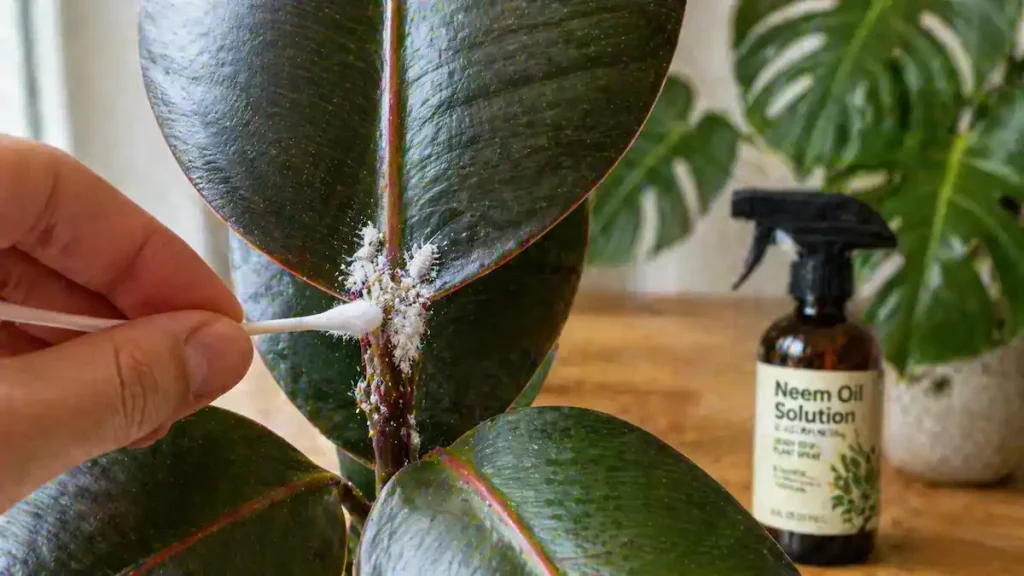
Quick Answer: Tiny white bugs on houseplants are almost always mealybugs — sap-sucking insects that hide in stem joints behind a fluffy white coating. Kill visible insects with 70% isopropyl alcohol on a cotton swab, then spray the whole plant with diluted neem oil or insecticidal soap. Repeat every five to seven days for four weeks to break the full lifecycle.
Tiny white bugs on houseplants — whether you are seeing small white bugs on plants, white fuzzy bugs in leaf joints, white cotton bugs on indoor plants, or a cottony white substance on stems — are almost always mealybugs. They are among the most common houseplant pests worldwide, and the reason most people fail to eliminate them is simple: they treat what they can see and miss what they cannot.
Most guides only address visible surface infestations. Root mealybugs in the soil — the real reason infestations keep returning — go untouched. In working through infestations across collections from succulents to ficus, the root system is where persistent cases almost always originate.
What you will learn:
- How to identify mealybugs versus white powdery mildew
- Whether mealybugs fly, live in soil, or spread to other plants
- Step-by-step treatment for surface and root infestations
- Organic remedies, systemic options, and biological control
- How to prevent re-infestation permanently and when to discard
What Causes White Bugs on Indoor Plants?
Mealybugs are soft-bodied insects in the family Pseudococcidae — sap-sucking pests that pierce plant tissue and feed on the fluid inside. The white waxy powder covering their bodies shields eggs and adults from drying out and makes them resistant to water-based sprays unless physically disrupted first.
They enter homes through newly purchased plants, contaminated potting soil, or clothing from infested greenhouses. Mobile juvenile nymphs called crawlers — the instar stages between egg and adult — spread between plants far faster than most people expect. A single female lays up to 600 eggs inside the same waxy coating that makes the colony so visible.
White Fuzzy Bugs on Plants: Identification Guide
Small white bugs on plants like mealybugs are easy to misidentify at first glance. To confirm: look for a slightly waxy texture when touched, slow-moving oval insects visible in bright light, and sticky honeydew residue on the pot or leaves below. All three together confirms mealybugs without further testing.

Mealybug crawlers — mobile juvenile nymphs at the instar stage — travel between touching leaves, across shelves, and through drainage holes. Adult females appear nearly stationary, but crawlers move continuously, spreading a single infestation to a full collection within days. This is why white bugs on plants rarely stay confined to one pot. Common species include the citrus mealybug (Planococcus citri) and longtailed mealybug (Pseudococcus longispinus). Root mealybugs (Rhizoecus spp.) live entirely in soil — often missed until a plant collapses despite surface treatment.
Distinguishing Between Mealybugs and White Powdery Mildew
Getting this identification wrong means applying the wrong treatment entirely. When white bugs on indoor plants turn out to be powdery mildew, treating with insecticide achieves nothing. Powdery mildew spreads as a flat, dusty film across leaf surfaces, does not cluster in joints, does not move, and leaves no sticky residue. Mealybugs cluster in three-dimensional fluffy masses in leaf axils and stem joints and always produce honeydew. Black sooty mould on or below the plant confirms an insect pest, not fungal disease.
Quick test: wipe the white area with a dry tissue. Powdery mildew smears flat and dusty. Mealybugs peel away in a clump and leave either the insect itself or sticky residue.
| Feature | Mealybugs | Powdery Mildew |
|---|---|---|
| Appearance | Fluffy, 3D waxy clusters in crevices | Flat, dusty film on leaf surfaces |
| Movement | Insects move when disturbed | Does not move |
| Sticky residue | Yes — honeydew present below plant | No sticky residue |
| Sooty mould | Common secondary symptom | Does not cause sooty mould |
| Treatment | Alcohol, neem oil, insecticidal soap | Fungicide, bicarbonate spray, better airflow |

Do Mealybugs Fly? How Fast Do They Spread?
Mealybugs do not fly. Adult females are wingless. Spread happens entirely through crawlers walking between plants, and through ants — which actively farm mealybugs for honeydew and physically carry crawlers to new host plants. In warm indoor conditions, a moderate infestation can reach a neighbouring pot within 48 hours. Check every plant within 60 cm (2 feet) of any confirmed case.
Can Mealybugs Live in Soil?
Yes. Root mealybugs (Rhizoecus spp.) live entirely in the soil and feed on root systems below the surface. They are most common in succulents, cacti, and orchids kept in drier soil. A plant treated repeatedly for visible mealybugs that keeps deteriorating almost certainly has a root infestation.
Treatment requires removing the plant from its pot, rinsing all soil from the roots under lukewarm water, soaking roots in diluted neem solution for 10–15 minutes, and repotting in completely fresh sterile mix. Mealybug eggs also survive in a dormant state within nursery pot crevices for several weeks — sterilise all containers with diluted bleach before reuse. Skipping this step is the most common reason mealybugs return after apparently successful treatment.
Root Mealybug TreatmentIf a plant keeps declining despite surface treatment, root mealybugs are almost certainly involved. Remove from the pot, rinse all soil from the roots, soak in diluted neem for 10–15 minutes, and repot in completely fresh sterile mix. Sterilise the old container — eggs survive in pot crevices for weeks.

How to Kill Mealybugs Instantly: The Isopropyl Alcohol Method
70% isopropyl rubbing alcohol kills mealybugs on contact by dissolving their waxy protective coating — something most households already have. Apply it with a cotton swab pressed directly onto each visible insect and cluster. For heavier infestations on large-leaved plants, use a soft cloth soaked in a 1:1 dilution of alcohol and water across the whole leaf surface.

This step must come before any spray treatment. Skipping it is the single most common reason first-time treatments fail — the waxy coating physically blocks spray penetration unless disrupted first. After treating adults with alcohol, the plant is primed for a follow-up spray application.
Best Two-Step Treatment MethodMealybugs are best removed using a two-step method: first kill visible insects with isopropyl alcohol applied by swab, then apply neem oil or insecticidal soap every 5–7 days for four weeks to eliminate newly hatched crawlers. The alcohol breaks the waxy coating so spray can penetrate. Both steps are required — skipping either significantly reduces effectiveness.
Natural Organic Remedies to Eradicate Mealybug Infestations Permanently
Neem Oil
Cold-pressed neem oil from Azadirachta indica is the most reliable organic option. It works as a contact insecticide and growth regulator through systemic translocation — the plant absorbs neem compounds through its tissue, making sap less attractive to feeding insects. Mix at 5 ml per litre with dish soap. Apply away from direct sunlight to prevent leaf scorch on sensitive plants.
Neem oil works as both a contact killer and a growth disruptor — for a deeper look at mixing ratios, application timing, and how it works across different growing systems, see this complete guide on ways to use neem oil in plants for pest and disease control.
Insecticidal Soap
Insecticidal soap penetrates the soft outer membrane of mealybugs and causes rapid dehydration on contact. It has no residual effect, so timing and full coverage are critical. Alternating between neem and insecticidal soap across treatment cycles is recommended by FAO IPM guidelines to reduce resistance risk — neem one week, soap the next.
Can You Use Vinegar?
Diluted white vinegar (1 part to 3 parts water) kills on contact through acidity but risks leaf burn on sensitive plants and has no residual effect. It is a useful emergency option only. Rubbing alcohol remains faster-acting, safer for most foliage, and more effective as the primary contact treatment.
Biological Control
For greenhouse settings or large collections, releasing Cryptolaemus montrouzieri — the mealybug destroyer beetle — is a highly effective biological control method. Adults and larvae feed on mealybug egg sacs and crawlers. Extension services in the UK, US, and Australia recommend this for large-scale infestations where repeated chemical application is impractical.
Systemic Pesticide Application for Recurring Indoor Plant Pests
Where organic methods are not controlling a severe infestation on non-edible plants, a soil drench with an imidacloprid-based systemic insecticide is the last-resort option. Systemic translocation through root uptake makes all plant sap toxic to feeding insects. Not appropriate for edible plants, organic programmes, or homes with pollinator access.
Why Your Rubber Plant or Fiddle Leaf Fig is a Mealybug Magnet
The surge in ficus plant popularity in 2026 — particularly rubber plants (Ficus elastica) and fiddle leaf figs (Ficus lyrata) — has made these among the most mealybug-prone purchases available. Their dense stem joints and large waxy leaves create ideal hiding spots, and infestations establish deep in leaf axils where spray coverage is difficult.
From experience treating ficus plants specifically, colonies that go past the first two weeks become significantly harder to resolve. Weekly inspection at every stem joint is non-negotiable. Always quarantine any new ficus purchase for two weeks before placing it near other houseplants — many arrive from nurseries with early-stage infestations already in the soil or stem joints.
How to Get Rid of Mealybugs Fast on Houseplants — Complete Step-by-Step
Step 1 — Isolate immediately. Move the plant away from all others before anything else. Crawlers travel fast and ants accelerate spread. Check every plant within 60 cm (2 feet).
Step 2 — Alcohol removal. Apply 70% isopropyl alcohol by cotton swab to every visible insect and cluster — all stem joints, leaf axils, and undersides. Non-negotiable first step.
Step 3 — Neem oil spray. Mix 5 ml neem per litre of warm water with dish soap. Spray the entire plant to runoff. Apply in early morning or evening, away from direct sun.
Step 4 — Root treatment if needed. If the plant keeps declining, repot in fresh sterile mix after rinsing all roots and soaking in diluted neem for 10–15 minutes. Sterilise the old pot.
Step 5 — Repeat every 5–7 days for four weeks. Eggs hatch over 7–14 days. Consistent repetition intercepts each new hatch. Keep the plant isolated until two weeks pass with no new signs.

Mealybug Control Methods at a Glance
| Method | Best For | Effectiveness | Organic? |
|---|---|---|---|
| Rubbing alcohol swab | Light to moderate infestations | High — contact kill | Yes |
| Neem oil spray | All infestation levels | High — contact and residual | Yes |
| Insecticidal soap | Crawlers, light infestations | Moderate — contact only | Yes |
| Cryptolaemus montrouzieri | Greenhouses, large collections | High — biological control | Yes |
| Systemic insecticide (imidacloprid) | Severe cases, non-edible plants only | Very high | No |
| Root soak (neem solution) | Root mealybug | Moderate to high | Yes |
How to Prevent Mealybugs Permanently
Quarantine every new plant for two weeks before placing it near existing houseplants — this eliminates the primary introduction route for mealybugs on houseplants. Inspect all plants weekly at stem joints. Maintain correct watering, light, and NPK feeding — stressed plants support heavier infestations. Sterilise all nursery pots with diluted bleach between uses.
Control ant access using a sticky barrier or ring of food-grade diatomaceous earth around pot bases. Ants actively carry mealybug crawlers between plants to farm them for honeydew. Removing ant access alone can halt re-infestation cycles in collections where ants reach indoor growing areas.
Prevention Checklist
✔ Quarantine all new plants for 2 weeks | ✔ Inspect stem joints weekly | ✔ Sterilise pots between uses | ✔ Block ant access with sticky barrier or diatomaceous earth | ✔ Maintain correct watering, light, and NPK balance — healthy plants resist infestation.
Mealybugs thrive in exactly the warm, enclosed conditions found in greenhouses and conservatories — growers managing larger plant collections can find a broader IPM framework for indoor and greenhouse pest control in this detailed guide on greenhouse pest and disease management.
Climate and Zone Relevance
In tropical and subtropical zones (USDA zones 10–13), mealybugs reproduce year-round above 25°C (77°F) — indoor air conditioning maintains the ideal breeding range of 22–28°C (72–82°F) regardless of season. In temperate zones (USDA zones 5–9), infestations peak in winter when central heating creates warm, dry conditions and reduced light weakens plant resistance — prevention programmes should start in late autumn. In continental and arid zones (USDA zones 3–7), heated indoor spaces create year-round ideal conditions despite low outdoor humidity, and succulents in these homes are disproportionately affected by root mealybugs.
When to Give Up and Discard the Plant
Discard only when the root system is completely destroyed and the plant shows no new growth after six weeks of consistent treatment. Most plants recover — strip damaged leaves, clean all surfaces with alcohol, treat the roots, repot in sterile soil, and maintain a four-week neem programme in isolation. When discarding, seal in a closed bag. Never compost — mealybug eggs survive in plant material and will establish in compost and re-infect through garden soil.
Common Mistakes That Let Mealybugs Keep Coming Back
- Stopping treatment after one or two sessions — four full weeks are required to intercept every hatch cycle
- Skipping the rubbing alcohol step before spraying — the waxy coating blocks spray penetration
- Not isolating the affected plant — crawlers reach neighbouring pots within hours
- Ignoring root mealybugs — persistent decline after surface treatment almost always means soil infestation
- Not sterilising nursery pots and not quarantining new plants — the two most common re-introduction routes
Mealybugs are rarely the only pest affecting a houseplant collection — for a comprehensive overview of identifying, preventing, and treating the full range of home garden pests and diseases using biological, chemical, and natural methods, this guide on pest and disease management in the home garden covers the complete picture.
Key Takeaways
- White bugs on plants are almost always mealybugs — confirm by fluffy 3D clusters in stem joints and sticky honeydew residue below
- Distinguish from powdery mildew: mealybugs are waxy and produce sticky residue — mildew is flat, dusty, and dry
- They do not fly — spread happens via crawlers walking between plants and ants physically carrying them
- Root mealybugs live in soil and need full repotting in fresh sterile mix — surface spray alone will not reach them
- Two-step method: alcohol on contact first, then neem spray every 5–7 days for four weeks — quarantine throughout and sterilise all pots
This guide is based on:
- University extension guides (UK, US, Australia, India)
- FAO integrated pest management manuals
- Cooperative extension services: UC IPM, RHS, ICAR
For the full scientific breakdown of mealybug species, lifecycle stages, and contact insecticide guidelines, the UC Statewide IPM Program’s mealybug management guide is the most comprehensive publicly available extension resource on houseplant and landscape control methods.
Gardeners in the UK and Europe can find region-specific identification photos, biological control release timing, and updated pesticide guidance for glasshouse and houseplant mealybugs on the Royal Horticultural Society’s mealybug advice page, which is updated regularly by their horticultural science team.
Are White Bugs on Plants Harmful?
Quick AnswerWhite bugs on plants — specifically mealybugs — are harmful to the plant but not to humans or pets. They weaken plants by extracting sap, cause yellowing and wilting, and produce honeydew that leads to black sooty mould. Left untreated, a moderate infestation can kill a houseplant within weeks.
Mealybugs do not bite — they feed only on plant sap. Their waxy secretions can cause mild skin reactions in sensitive individuals during prolonged handling, so gloves are sensible. The greater indoor risk is the sooty mould that grows on honeydew — airborne spores can aggravate respiratory sensitivities in enclosed spaces.
Frequently Asked Questions about Tiny White Bugs on Houseplants
1. Why do mealybugs keep coming back after treatment?
The most common cause is incomplete treatment. Eggs in pot crevices or soil hatch 7–14 days after adults are killed, restarting the cycle. Root mealybugs are also frequently missed — invisible above soil, they survive surface-only treatment entirely. Extend to four full weeks, sterilise all containers, inspect the root system, and keep the plant isolated until two clear weeks pass with no new activity.
2. Do mealybugs fly, and how fast do they spread?
Mealybugs do not fly — adult females are wingless. Spread happens through mobile crawler nymphs walking between plants and through ants that physically carry crawlers to new hosts. A confirmed infestation can reach a neighbouring pot within 48 hours in warm indoor conditions. Isolate the affected plant immediately and check every plant within 60 cm (2 feet).
3. Can mealybugs live in the soil?
Yes. Root mealybugs (Rhizoecus spp.) live entirely in the soil and feed on root systems. Most common in succulents, cacti, and orchids. A plant that keeps declining after surface treatment almost certainly has root mealybugs. Remove from the pot, rinse all soil from the roots, soak in diluted neem for 10–15 minutes, and repot in completely fresh sterile mix.
4. What kills mealybugs instantly?
70% isopropyl alcohol kills mealybugs on contact by dissolving their waxy coating. Applied by cotton swab directly to insects and clusters, it is the fastest-acting method without chemical pesticides. It does not kill eggs or unhatched crawlers, so it must always be followed by a four-week neem or insecticidal soap spray programme to eliminate all lifecycle stages. Alcohol alone will not resolve an established infestation.
5. Do ants cause mealybugs?
Ants do not cause mealybugs but actively spread them — they farm mealybugs for honeydew and physically carry crawlers to new host plants. If ants are present around houseplants, treat them as a mealybug spread risk. A sticky barrier or ring of food-grade diatomaceous earth around pot bases cuts off ant access effectively.
6. When should I discard a mealybug-infested plant?
Discard only when the root system is completely destroyed and the plant shows no new growth after six full weeks of consistent treatment. Most plants recover with committed effort. When discarding, seal in a closed bag before removal — do not compost. Mealybug eggs and crawlers survive in plant material and re-establish from compost into garden soil.
Conclusion
Knowing how to get rid of mealybugs fast starts with the right sequence. Isolate first, use rubbing alcohol on contact, follow with neem oil spray every five to seven days for four weeks, and treat the roots separately if the plant keeps declining. Most failed treatments share the same pattern: stopping too early, missing the root system, and not sterilising containers. Getting those three things right separates a plant that recovers from one that stays permanently re-infested.
Start with what you already have. A cotton swab and rubbing alcohol is all you need for the first step. The plant has a very good chance of full recovery if treatment begins within the first few days.
Note: Mealybug control improves plant health outcomes but should be combined with proper watering, appropriate light, balanced nutrition, and good air circulation for best long-term results. Results vary by climate zone, plant species, infestation severity, and local pest pressure. Test any spray on a small area first. Systemic insecticides should only be used on non-edible plants and per label instructions.
















Leave a Comment
Your email address will not be published. Required fields are marked with *