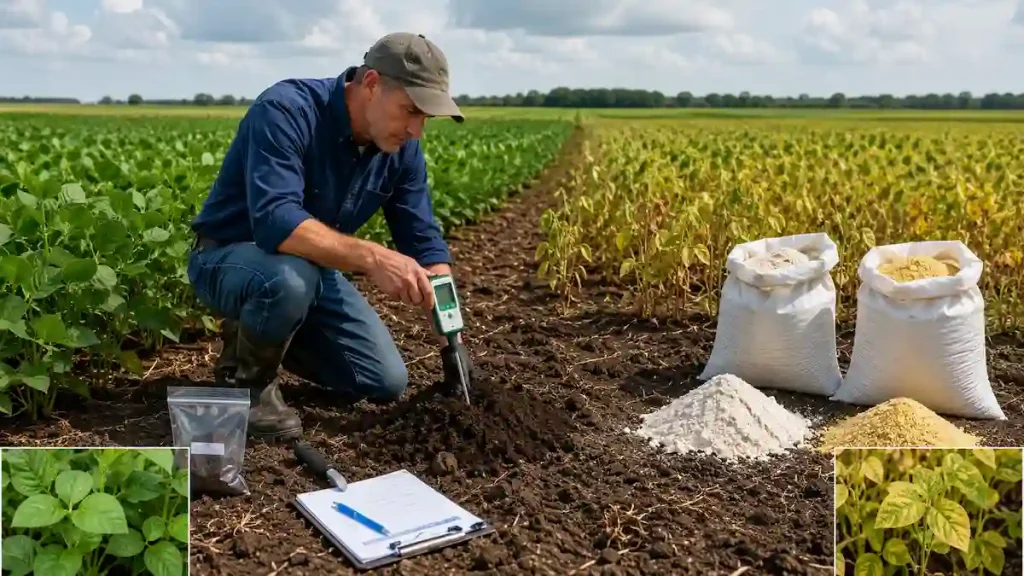
What Is Soil pH? Soil pH is a measurement of soil acidity or alkalinity on a scale of 0 to 14. Most crops grow best between pH 6.0 and 7.0 because nutrients remain readily available to plant roots in that range. [ soil_ph_calculator ] If crops are not responding to fertilizer, poor soil pH is
What Is Soil pH? Soil pH is a measurement of soil acidity or alkalinity on a scale of 0 to 14. Most crops grow best between pH 6.0 and 7.0 because nutrients remain readily available to plant roots in that range.
[ soil_ph_calculator ]
If crops are not responding to fertilizer, poor soil pH is usually the first place to look. The soil pH calculator above gives you instant lime or sulfur requirements based on your current pH, target pH, and soil type.
Many fertilizer problems are actually pH problems. Nutrients may already be present in your soil but stay locked up and unavailable to roots when pH is off. Fixing pH first makes every other input work better.
Enter your current soil pH in the calculator above. Then use the crop pH chart and soil testing guide below to understand your results and plan your next move.
Ideal Soil pH for Most Crops
Quick Answer: Most crops grow best at a soil pH between 6.0 and 7.0. This range maximizes nutrient availability, microbial activity, and fertilizer efficiency while minimizing nutrient deficiencies and toxicities. Acid-loving crops like blueberries (4.5 to 5.5) and potatoes (4.8 to 5.5) are the main exceptions.
Soil pH Chart: What Your Reading Means
Use this quick reference to understand where your soil stands before diving into the full calculator results.
| Soil pH | Classification | Crop Suitability |
| Below 4.5 | Extremely Acidic | Very few crops tolerate this |
| 4.5 to 5.5 | Strongly Acidic | Blueberries, cranberries, potatoes |
| 5.5 to 6.0 | Moderately Acidic | Sweet potato, oats, rye |
| 6.0 to 7.0 | Neutral / Ideal | Most vegetables, grains, legumes |
| 7.0 to 7.5 | Mildly Alkaline | Asparagus, brassicas, barley |
| Above 7.5 | Strongly Alkaline | Requires sulfur amendment |
Compare your soil pH reading from the calculator above with this chart to see where you land.

Ideal Soil pH for Common Crops: Quick Reference
This table covers the most searched crop pH requirements. For detailed sections by crop type, scroll further below.
| Crop | Ideal Soil pH | Key Note |
| Rice | 5.5 to 6.5 | Tolerates mild acidity |
| Wheat | 6.0 to 7.0 | Drops sharply below 5.5 |
| Maize / Corn | 5.8 to 7.0 | Wide tolerance, best near 6.5 |
| Tomato | 6.0 to 6.8 | Sensitive to pH swings |
| Potato | 4.8 to 5.5 | Low pH reduces scab disease |
| Soybean | 6.0 to 7.0 | N-fixation fails below 6 |
| Cotton | 5.8 to 8.0 | Broad tolerance |
| Blueberry | 4.5 to 5.5 | Very specific requirement |
| Groundnut | 5.5 to 7.0 | Needs calcium for pod fill |
| Carrot | 6.0 to 6.8 | Neutral soil for best shape |
Enter your crop’s target pH in the soil pH calculator above to get the lime or sulfur rate you need.
How to Use the Soil pH Calculator
The soil pH calculator above has five fields. Fill them in order and click Analyse Soil pH to get your lime or sulfur requirement in kg/ha and total kg for your field size.
Field 1: Current Soil pH (Required)
Enter your measured soil pH reading. Accepts values between 3 and 10 in 0.1 steps. If you have not tested yet, use a digital pH meter, test kit, or lab report first. Lab reports give the most accurate input for the calculator.
Example: if your meter reads 5.5, enter 5.5.
Field 2: Target pH
This defaults to 6.5, which suits most grain and vegetable crops. Change it to match your specific crop. Select your crop in Field 5 first and the calculator will display the optimal pH range as a hint below the crop dropdown.
| Crop | Set Target pH To |
| Rice | 5.5 to 6.5 |
| Wheat | 6.0 to 7.0 |
| Maize | 5.8 to 7.0 |
| Tomato | 5.5 to 7.0 |
| Blueberry | 4.5 to 5.5 |
| Alfalfa | 6.5 to 7.5 |
Field 3: Field Area (Required)
Enter your field size and choose the unit from the dropdown next to it: hectares (ha) or acres. The calculator converts acres to hectares internally. Area must be greater than zero.
Example: enter 2 and select ha for a 2-hectare field, or enter 5 and select Acres for a 5-acre field.
Field 4: Soil Texture
Choose the texture that best describes your soil. This is the most important setting for accuracy because lime and sulfur rates change significantly by texture.
| Soil Texture | Lime kg/ha per 0.1 pH unit | Sulfur kg/ha per 0.1 pH unit |
| Sandy | 150 | 30 |
| Sandy Loam | 200 | 45 |
| Loam (default) | 250 | 60 |
| Clay Loam | 300 | 75 |
| Clay | 350 | 90 |
If unsure, select Loam. It is the mid-range default. Choosing the wrong texture by one class typically shifts the result by 20 to 40 percent, so it is worth checking before relying on the output for large fields.
Field 5: Intended Crop (Optional)
Select your crop from the dropdown. When you pick a crop, a hint appears below showing the optimal pH range for that crop. Use that hint to guide your target pH entry in Field 2.
Available crops in the dropdown: Rice, Wheat, Maize, Potato, Tomato, Soybean, Cotton, Blueberry, Alfalfa. If your crop is not listed, leave this field blank and refer to the crop pH charts further down this page.
Click Analyse Soil pH
Once all fields are filled, click the Analyse Soil pH button. Results appear immediately below the calculator without a page reload.
Reading Your Results
The results panel shows six values:
- Current pH: your input reading with pH classification (e.g. Strongly Acidic, Near Neutral)
- Target pH: your entered target
- Amendment Type: Agricultural Lime (CaCO3) if pH needs to rise, Elemental Sulfur (S) if pH needs to drop, or None Needed if already at target
- Amount per ha: kg of lime or sulfur needed per hectare
- Total Amount: total kg for your full field area, plus the equivalent in 50 kg bags
- Field Area: your input area converted to hectares for confirmation
Below the figures, the calculator shows a step-by-step calculation breakdown and a plain-English recommendation covering application method, incorporation depth, and retest timing.
If the Result Shows No Amendment Needed
If your current pH is within 0.1 units of your target, the calculator shows a green status and confirms no lime or sulfur is required. Monitor pH annually and retest before the next season.
Recalculate or Reset
Use the Recalculate button on the results panel to go back and adjust any input. Use the Reset button to clear all fields and start fresh. The Copy button copies your results as plain text for pasting into notes or a spreadsheet.
Tip: run the calculator twice for large fields — once with your current pH and once after amendment to confirm your target will be reached at the rate you plan to apply.

How Soil pH Affects Crop Yield and Nutrient Uptake
Nitrogen Availability by pH
Many growers notice nitrogen problems first in acidic soils because beneficial soil bacteria slow down as pH falls. Below pH 5.5, the microbes that convert organic nitrogen into plant-available forms go largely inactive. You can add nitrogen, but the soil biology needed to cycle it is impaired.
Phosphorus Availability by pH
Phosphorus has the narrowest available window, between pH 6.0 and 7.0. Below pH 5.5, it binds to iron and aluminum. Above pH 7.5, it locks to calcium. Growers often blame fertilizer quality when pH is the real problem.
Before applying additional nutrients, use our Fertilizer Calculator to estimate the correct nutrient requirements for your crop and soil conditions.
Potassium, Calcium, and Magnesium
Potassium stays available from pH 6.0 to 8.0. Calcium and magnesium are most available above pH 6.5 and drop sharply in acidic soil. Dolomitic lime corrects both pH and magnesium in one step, which is why it is often preferred over calcitic lime on leached sandy soils.
Micronutrient Behavior at Different pH Levels
| Nutrient | Deficient In | Toxic In |
| Iron (Fe) | Alkaline soil above 7.5 | Acidic soil below 5.0 |
| Zinc (Zn) | Alkaline soil above 7.0 | Acidic soil below 5.5 |
| Manganese (Mn) | Alkaline soil above 7.0 | Acidic soil below 5.0 |
| Boron (B) | Alkaline soil above 7.5 | Rarely a problem |
If your crop shows micronutrient deficiency symptoms, compare your soil pH calculator reading with this table before buying supplements.

How Incorrect Soil pH Reduces Crop Yield
Nutrient Lockup
This is the most direct yield driver. When pH sits outside the optimal range for your crop, one or more essential nutrients become chemically unavailable. Plants show deficiency symptoms even when nutrients are physically present in the soil. Applying more fertilizer without fixing pH gives little return.
Root Restriction from Aluminum and Manganese Toxicity
In acidic soil below pH 5.0, aluminum and manganese dissolve into the root zone at damaging levels. Roots become short and stubby, brown-tipped, and fail to penetrate deep soil. Shallow roots mean less access to water and subsoil nutrients, which compounds yield loss during dry periods.
Reduced Fertilizer Efficiency
Every dollar spent on nitrogen, phosphorus, and potassium gives a lower return when pH is wrong. University extension research consistently shows that lime application on acidic soil improves fertilizer response by 20 to 40 percent. The input cost does not change. The crop’s ability to use those inputs does.
Lower Water Uptake and Drought Stress
Damaged root systems from pH-related toxicity reduce the crop’s ability to extract water efficiently. Fields with chronic pH problems often show drought stress faster than surrounding fields during dry spells, even when soil moisture levels are similar.
Compound Yield Loss Over Seasons
A single season of poor pH rarely causes catastrophic loss. But two or three seasons of suboptimal pH compounds the damage. Soil organic matter declines because microbial activity slows. Fertilizer costs rise because efficiency drops. Yield potential decreases each year the pH problem is unaddressed.
Use the soil pH calculator above to estimate your amendment need. Even a small pH correction toward the ideal range often produces measurable yield improvement within one season.
After correcting soil pH, use our Crop Yield Calculator to estimate expected production and compare results across growing seasons.
Common Causes of Soil pH Changes
Heavy Rainfall and Leaching
In high-rainfall regions, soil gradually becomes more acidic as calcium and magnesium wash deeper into the profile. Hydrogen ions replace them at the root zone, pulling pH down. Southeast Asia, tropical Africa, and the US Southeast all see fast natural acidification in cropped soils.
Ammonium-Based Fertilizers
Urea, ammonium sulfate, and monoammonium phosphate all acidify soil over time. Ammonium sulfate is the most aggressive: it requires about 110 lbs of agricultural lime per 100 lbs applied just to offset the pH drop. Long-term corn and rice systems relying heavily on urea show consistent acidification without lime maintenance.
Irrigation Water Quality
Irrigation water high in bicarbonate raises soil pH over time. This is a common issue in arid farming regions. Water testing above 120 ppm bicarbonate can push soil pH above 7.5 after several seasons, especially in poorly drained fields with minimal rainfall leaching.
Water quality and irrigation management often influence soil chemistry, so our Irrigation Water Requirement Calculator can help plan efficient water use alongside soil pH management.
Limestone Parent Material
Soils formed over limestone or chalk rock are naturally alkaline. Correcting these soils with sulfur is possible but requires repeated applications. Choosing alkali-tolerant crops is often more practical than trying to permanently lower pH on deep calcareous soils.

Soil pH Management by Soil Type
Sandy Soil
Sandy soils have low buffering capacity and respond quickly to lime or sulfur. A small amendment moves pH fast, which can be a problem if you over-apply. Use the lower end of calculator recommendations for sand and retest at 2 to 3 months rather than waiting the full 6.
Loamy Soil
Loam buffers pH changes moderately. Standard calculator rates work accurately here, which is why loam is used as the reference baseline in most lime requirement tables. Amendment response is predictable and stable.
Clay Soil
Clay resists pH change due to high cation exchange capacity (CEC). You need two to three times more lime or sulfur than sandy soil to achieve the same shift. Never apply the maximum calculator rate to clay all at once. Split into two applications across seasons for safer, more controlled results.
How to Test Soil pH Before Using the Calculator
Digital Soil pH Meter
Insert the probe 4 to 6 inches deep into moist soil. Take 5 to 10 readings per field and average them. Meters cost $15 to $150. Calibrate with buffer solution every few months for consistent accuracy.
Soil Test Kit
Chemical kits use indicator solution that changes color by pH level. Under $20 and accurate enough for a general baseline. Test in natural daylight for the most reliable color matching.
Laboratory Soil Testing
A lab report gives pH, buffer pH, organic matter, nitrogen, phosphorus, potassium, and micronutrients in one result. University extension labs charge $15 to $30 per sample.
When reading a lab report, pay attention to buffer pH, not just water pH. Buffer pH is a laboratory measurement used to estimate how much lime is needed to raise soil pH. Two soils with the same water pH can require very different lime rates because their buffering capacities differ. Clay soils and high-organic-matter soils have stronger buffering capacity and always need more lime than sandy soils at the same pH reading. Enter the buffer pH value into the lime requirement calculator whenever your lab report provides it.
| Method | Cost | Best Use |
| Digital pH meter | $15 to $150 | Regular monitoring |
| Chemical test kit | Under $20 | Quick garden check |
| Lab test | $15 to $30 | Farms, new fields, problem soils |
Lime Requirement Calculator Results Explained
Agricultural Lime vs Dolomitic Lime
Calcitic lime (agricultural lime) supplies calcium carbonate. Use it when magnesium levels are adequate. Dolomitic lime adds both calcium and magnesium carbonate. It is the better choice when both pH and magnesium are low, common in heavily leached sandy soils.
| Type | Main Nutrient | When to Use |
| Calcitic lime | Calcium | Mg levels are adequate |
| Dolomitic lime | Calcium + Magnesium | Mg is also deficient |
| Hydrated lime | Calcium | Fast-acting, handle carefully |
How Much Lime Is Needed?
Sandy soil needs roughly 25 to 50 lbs of agricultural lime per 1,000 sq ft to raise pH by one unit. Clay soil needs 75 to 100 lbs for the same shift. Use the lime requirement calculator results as your starting point, then verify with a follow-up test.
Best Time to Apply Lime
Fall is ideal because lime needs time to dissolve and react with soil moisture over winter. Spring application works but pH may not fully shift before planting. For established perennial crops, surface apply and retest at 6 to 12 months.
What About Gypsum?
Gypsum (calcium sulfate) does not change soil pH. It supplies calcium and sulfur and can improve structure in sodic soils, but it is not a substitute for lime when pH correction is the goal. Do not use the lime requirement calculator results to guide gypsum applications.

Sulfur Requirement Calculator Results Explained
Elemental Sulfur vs Iron Sulfate
Elemental sulfur is the most economical option for lowering pH. Soil bacteria oxidize it into sulfuric acid over 3 to 6 months. It works faster in warm, moist conditions with active soil biology.
Iron sulfate (ferrous sulfate) reacts without needing bacteria, producing results in 2 to 4 weeks. More expensive but useful before planting blueberries or potatoes when time is limited.
| Product | Speed | Cost | Best For |
| Elemental sulfur | 3 to 6 months | Low | Long-term pH management |
| Iron sulfate | 2 to 4 weeks | Higher | Fast pre-plant correction |
How Much Sulfur Is Needed?
To lower sandy soil pH by one unit, roughly 10 to 15 lbs of elemental sulfur per 1,000 sq ft. Clay soil needs two to three times that. Never apply more than 5 lbs per 1,000 sq ft in a single pass to avoid root injury.
Factors That Affect How Fast Sulfur Works
- Soil temperature: works fastest above 60 degrees F
- Soil moisture: needs adequate moisture for microbial activity
- Particle size: finely ground sulfur reacts faster
- Organic matter: high-OM soils buffer against rapid pH drop
Ideal Soil pH for Vegetables
Vegetable crops have tighter pH tolerance than most field crops. Getting soil pH right before planting season is more effective than trying to correct problems after transplant.
Most vegetables perform best between pH 6.0 and 6.8. Below 6.0, manganese and aluminum can become problems. Above 7.0, iron and zinc deficiency become common.
Best Soil pH for Tomatoes
Tomatoes grow best between pH 6.0 and 6.8. Outside this range they develop blossom end rot more frequently, partly because calcium uptake is impaired at low pH. If your soil pH calculator reading is below 6.0 for tomatoes, lime is needed before planting.
Best Soil pH for Potatoes
Potatoes prefer pH 4.8 to 5.5, lower than most crops. This is intentional. Common scab disease, caused by Streptomyces bacteria, is suppressed below pH 5.5. Raising pH above 6.0 to plant potatoes increases scab risk significantly.
Soil pH for Other Common Vegetables
| Vegetable | Ideal pH | Key Note |
| Tomato | 6.0 to 6.8 | Sensitive to pH swings |
| Potato | 4.8 to 5.5 | Low pH reduces scab |
| Carrot | 6.0 to 6.8 | Neutral soil for best shape |
| Spinach | 6.5 to 7.5 | Prefers mildly alkaline |
| Pepper | 6.0 to 7.0 | Standard vegetable range |
| Onion | 6.0 to 7.0 | Narrow tolerance |
| Cucumber | 6.0 to 7.0 | Sensitive to acidity |
| Lettuce | 6.0 to 7.0 | Consistent performer |
Use the soil pH calculator above to find how much lime or sulfur you need to reach the ideal vegetable pH for your garden or field.

Ideal Soil pH for Fruit Trees and Berry Crops
Fruit crops are some of the most pH-sensitive plants you can grow. Getting pH wrong at establishment is costly because perennial crops stay in the ground for years.
Before planting any fruit tree or berry crop, test soil pH and use the lime or sulfur requirement calculator to correct it. Amendment takes months to work, so start at least a season ahead of planting.
Soil pH for Blueberries
Blueberries are the strictest of all. They require pH 4.5 to 5.5. Above pH 6.0, blueberry plants develop severe iron deficiency and yellowing within one season. Most soils need aggressive sulfur amendment before planting. Use the sulfur requirement calculator results with iron sulfate for fastest correction.
Soil pH for Apples, Grapes, and Stone Fruits
| Fruit | Ideal pH | Key Note |
| Blueberry | 4.5 to 5.5 | Very specific, pre-plant correction needed |
| Strawberry | 5.5 to 6.5 | Slightly acidic preferred |
| Raspberry | 5.5 to 6.5 | Similar to strawberry |
| Apple | 6.0 to 7.0 | Standard range, flexible |
| Grape | 5.5 to 6.5 | Sensitive to alkalinity |
| Peach | 6.0 to 6.8 | Similar to apple |
| Mango | 5.5 to 7.5 | Adaptable but dislikes extremes |
| Citrus | 6.0 to 7.0 | Sensitive to both extremes |
Ideal Soil pH for Field Crops
Field crop soil pH management works at scale. The cost of lime or sulfur is small compared to the yield gain from correct pH. Most extension services recommend soil testing every 2 to 3 years and amending before it becomes a problem.
You can also use our Crop Profit Calculator to evaluate how improved yields from proper soil pH management may affect farm profitability.
Soil pH for Rice and Wheat
Rice grows best between pH 5.5 and 6.5 and tolerates flooding conditions that naturally buffer acidity. Wheat is more sensitive, performing poorly below pH 5.5 where aluminum toxicity restricts root growth and reduces grain fill.
Soil pH for Maize, Sorghum, and Cotton
Maize performs across a wider range, pH 5.8 to 7.0, but yield peaks near pH 6.5. Sorghum is more acid-tolerant than maize and manages down to pH 5.5. Cotton has broad tolerance from pH 5.8 to 8.0 but shows the best fiber quality near neutral pH.
Field Crop Soil pH Reference Table
| Crop | Ideal pH | Sensitive Below |
| Wheat | 6.0 to 7.0 | 5.5 |
| Rice | 5.5 to 6.5 | 5.0 |
| Maize / Corn | 5.8 to 7.0 | 5.5 |
| Sorghum | 5.5 to 7.5 | 5.0 |
| Barley | 6.5 to 7.5 | 5.5 |
| Soybean | 6.0 to 7.0 | 5.8 |
| Groundnut | 5.5 to 7.0 | 5.0 |
| Cotton | 5.8 to 8.0 | 5.5 |
| Chickpea | 6.0 to 8.0 | 5.5 |
| Sunflower | 6.0 to 7.5 | 5.5 |
Enter any crop’s target pH from the table above into the soil pH calculator to get your lime or sulfur amendment rate.

Common Signs of Soil pH Problems in the Field
Symptoms of Acidic Soil
Farmers often notice acidic soil when crops stay stunted even after fertilizer applications. Other signs:
- Older leaves turning yellow from calcium and magnesium deficiency
- Short, brown-tipped roots from aluminum toxicity
- Moss or lichen on bare soil patches
- Poor legume performance and thin stands
- Phosphorus deficiency despite regular applications
Symptoms of Alkaline Soil
Alkaline soils are common in dry regions where farmers frequently struggle with iron deficiency and yellowing leaves. Look for:
- Yellow leaves with green veins on new growth (iron or manganese deficiency)
- Poor fruit color and small size despite good fertilizer use
- White salt crust on soil surface
- Phosphorus deficiency even with adequate applications
When Deficiency Is Actually a pH Problem
Before buying micronutrient supplements, run a soil pH test. Iron chlorosis looks like nitrogen deficiency but does not respond to nitrogen at all. The fix is pH correction.
If your soil pH calculator reading falls outside the ideal range for your crop, correct pH first. Retesting after amendment often shows nutrient levels were adequate all along.
Soil pH Troubleshooting Guide
Soil pH Not Changing After Lime Application
The most common reason is not enough time. Lime needs 3 to 6 months minimum to react with soil. If you tested within 4 to 6 weeks of application, retest at the 3-month mark before concluding it is not working.
Second reason: too little lime for your soil type. Clay soils buffer heavily. A rate that works on sandy loam will barely move clay pH. Rerun the lime requirement calculator using the clay soil setting and compare to what you applied.
Third reason: water pH. If your irrigation water is high in bicarbonate, it counteracts lime applications over time. Test your water source and consider acidification treatment if bicarbonate exceeds 120 ppm.
Soil pH Not Decreasing After Sulfur Application
Elemental sulfur requires warm soil and active bacteria to oxidize. Applications in cold soil below 55 degrees F or dry soil show little movement for months. If you applied in late fall or during drought, results will lag.
Also check particle size. Coarsely ground sulfur reacts much slower than finely ground material. For fastest results, use fine-grade elemental sulfur or switch to iron sulfate, which does not need microbial action.
Uneven Soil pH Across a Field
Patchy pH is more common than most growers expect. Causes include variable lime application in past seasons, topsoil erosion exposing subsoil with different pH, tree root decomposition zones, and differences in drainage that concentrate salts.
Grid soil sampling every 2 to 3 acres gives a clearer picture. Variable-rate lime spreading based on a grid map is the most cost-effective fix for large fields with pH variation.

Soil pH Changes Too Quickly After Amendment
This usually indicates a sandy soil with very low buffering capacity or organic matter. Sandy soils do not hold pH stable. A small amount of lime or sulfur can overshoot the target quickly.
Solution: apply at half the calculator rate, retest at 6 weeks, and apply again if needed. Also build organic matter with compost additions, which increases CEC and makes pH more stable over time.
Soil pH Management for Organic Farming
Organic pH Correction Options
Conventional agricultural lime and elemental sulfur are both acceptable in certified organic production. Wood ash raises pH similarly to lime but with lower neutralizing value. Apply at 10 to 15 lbs per 1,000 sq ft and retest after 3 months.
Composted pine bark and peat moss lower pH slightly over time. They are useful for blueberry beds but too slow for rapid correction.
Role of Organic Matter in pH Buffering
High organic matter stabilizes soil pH by increasing cation exchange capacity. Soils with 4 percent or more organic matter resist pH swings better than low-OM soils. Building organic matter through cover crops, compost, and reduced tillage is the best long-term pH stability strategy.
Soil Microorganisms and pH
Soil bacteria and fungi are most active between pH 6.0 and 7.5. Acidic soil below pH 5.5 suppresses bacterial activity and shifts populations toward fungi. This slows nitrogen cycling and makes soil less responsive to inputs.
Correcting pH to the 6.0 to 7.0 range restores microbial activity and helps release nutrients from organic matter naturally, reducing the need for purchased inputs.
How to Raise or Lower Soil pH Safely
Raising Soil pH with Lime
Work lime into the top 6 to 8 inches before planting. Fall application gives the best results. For no-till fields, surface apply and let rainfall carry it down gradually over several months.
Do not exceed 5 tons of lime per acre per application. Over-liming above pH 7.5 creates its own micronutrient problems, particularly manganese and iron deficiency.
Lowering Soil pH with Sulfur
Mix elemental sulfur into the top 8 to 10 inches of soil. Split applications exceeding 5 lbs per 1,000 sq ft into two passes, 4 to 6 weeks apart, to avoid root injury.
For potted plants or raised beds, acidifying fertilizers like ammonium sulfate can maintain lower pH alongside sulfur applications over time.
Adding Organic Matter for Long-Term Stability
Compost buffers both acidic and alkaline soils. It does not make rapid pH corrections but reduces drift between amendments. Adding 2 to 3 inches of compost annually is one of the most cost-effective soil pH management tools any grower can use.
If you plan to improve soil organic matter, try our Compost Calculator to estimate how much compost is needed for your field, garden, or raised bed.
Monitor with Regular Retesting
Test every 2 to 3 years under normal conditions. Test annually when actively correcting pH or growing crops with tight requirements. Keep records of pH readings, amendment rates, and crop yields to identify trends.
Why Correct Soil pH Increases Crop Yield
Lime application on acidic soil consistently raises crop yields by 15 to 30 percent before any additional fertilizer is added. The mechanism is direct: when pH improves, nutrients that were already in the soil become available to roots.
Root development improves immediately. Correcting pH eliminates aluminum toxicity, allowing roots to grow deep and access subsoil water and nutrients. This builds drought tolerance across the growing season.
Fertilizer efficiency rises. Every dollar spent on nitrogen, phosphorus, and potassium gives a higher return when soil pH sits in the right range. The soil pH calculator results, followed through to completion, often deliver the highest return on investment of any soil management step you can take.
References
Soil pH and Nutrient Availability – Penn State Extension
Soil pH Management – University of Minnesota Extension
Understanding Soil pH – USDA NRCS Soil Quality Resources
Frequently Asked Questions About Soil pH
What is the ideal soil pH for most crops?
Most vegetable and grain crops grow best between pH 6.0 and 7.0. In this range, nitrogen, phosphorus, potassium, calcium, and magnesium all stay plant-available. Exceptions include blueberries (4.5 to 5.5), potatoes (4.8 to 5.5), and asparagus (up to pH 8.0).
How much lime does it take to raise soil pH by 1 unit?
Sandy soil needs about 25 to 50 lbs of agricultural lime per 1,000 sq ft. Clay soil needs 75 to 100 lbs for the same shift. Always use buffer pH from a soil lab report for the most accurate lime requirement calculator result on large acreage.

How long does sulfur take to lower soil pH?
Elemental sulfur needs 3 to 6 months in warm, moist soil. Iron sulfate works in 2 to 4 weeks. Use iron sulfate when you need fast pH reduction before planting. Use elemental sulfur for long-term pH management where cost matters.
Can fertilizers change soil pH?
Yes. Ammonium sulfate and urea acidify soil over time with repeated use. Nitrate-based fertilizers have little effect. Over several seasons, fertilizer choice can shift soil pH by 0.5 to 1.0 unit. Include fertilizer type in your soil pH management plan.
Can I Apply Lime and Fertilizer at the Same Time?
Generally, no. Lime and nitrogen fertilizers should not be applied together or within the same week. Lime raises soil pH quickly at the point of contact, which accelerates ammonia volatilization from urea and ammonium-based fertilizers. You lose nitrogen to the air before it enters the soil.
The safe approach: apply lime first, incorporate it, wait at least 2 to 4 weeks, then apply fertilizer. For phosphorus and potassium fertilizers, timing is less critical, but separating applications by at least a few days is still good practice.
How accurate is the soil pH calculator?
The calculator uses standard agronomic formulas based on soil type and pH differential. It gives a reliable starting estimate. For large-scale farming or tight pH requirements, confirm results with a professional soil lab test and your local USDA Cooperative Extension Service.
Conclusion
Key Takeaways for Farmers and Gardeners
Soil pH is the single biggest factor controlling nutrient availability. Getting it in range before planting does more for yield than adding extra fertilizer. Use the soil pH calculator at the top of this page to find your lime or sulfur requirement.
Match amendment rates to your soil type, apply at the right time, and retest at 3 to 6 months. Use the crop pH charts on this page to confirm your target before entering numbers into the calculator.
Using Soil pH Data to Improve Crop Performance
pH management is not a one-time fix. Soils drift over time from rainfall, fertilizer use, and crop removal of calcium and magnesium. Build soil testing into your annual or biannual routine and track results across seasons.
Farmers who consistently manage soil pH outperform those who do not. The soil pH chart, lime requirement calculator, sulfur requirement calculator, and troubleshooting guide on this page are the tools. Your soil test is the starting point.
Disclaimer: Information on this site is for educational purposes only. Results vary by climate, soil, weather, and growing conditions. For region-specific advice, consult your local USDA Cooperative Extension Service before making major farming or soil changes.









Leave a Comment
Your email address will not be published. Required fields are marked with *