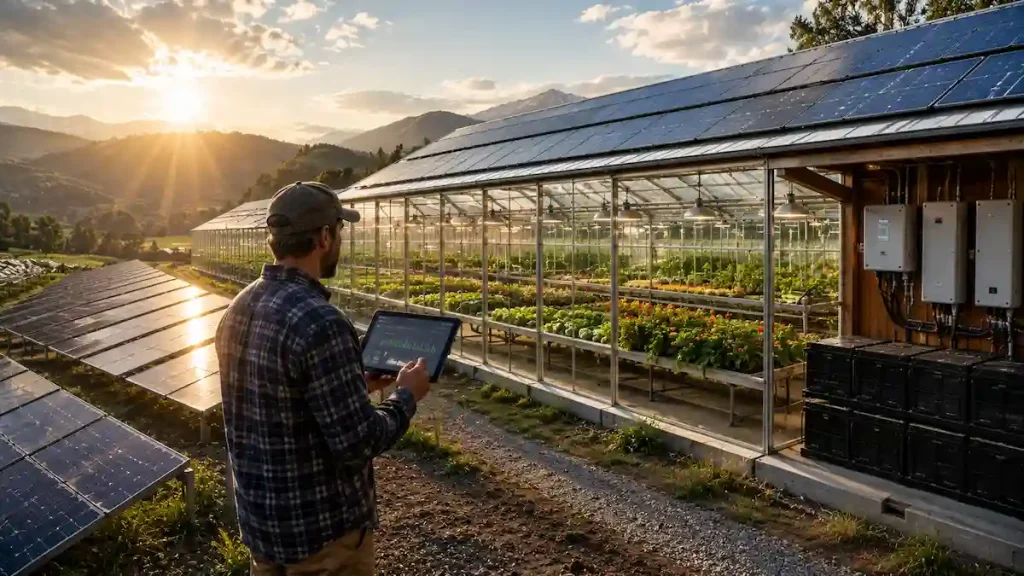
In an effort to create more sustainable farming practices, many professionals are adopting renewable energy generators on their properties. Solar power is one of the most common, but determining how many panels you need to support a greenhouse requires planning. Follow these steps to accurately estimate how much equipment you’ll need to light, heat and
In an effort to create more sustainable farming practices, many professionals are adopting renewable energy generators on their properties. Solar power is one of the most common, but determining how many panels you need to support a greenhouse requires planning. Follow these steps to accurately estimate how much equipment you’ll need to light, heat and cool your buildings without relying on fossil fuel-powered generators ever again. The key is to use the right calculations for sizing a solar system for your greenhouse.
Calculate Your Total Daily Energy Consumption

Determine how much energy your greenhouse uses every day. Get an average across varying temperatures to see the high and low extremes. There are a few ways to accomplish this.
First, review all equipment and growth chambers in the greenhouse, including air conditioners and smart devices. Labels will indicate the expected power consumption in watts (W). Alternatively, you can have an energy audit, where a professional can use a watt meter to measure the space. There are also DIY watt meters.
With these methods, you can determine how much power you use for lighting, heating and cooling, culminating in your total daily load. Here are several examples:
- Lighting: If you have 15 100-watt grow lights that run for 16 hours a day to help when natural light isn’t enough, convert this to watt-hours. Multiply bulbs by watts, then multiply again by hours to get 24,000 Wh.
- Heating: If you have a 1,200-watt heater and it runs for eight hours on a cooler night, multiply the two numbers to get 9,600 Wh.
- Cooling: If you have two 200-watt circulation fans running for 10 hours a day, multiply the number of fans by the wattage, then again by the hours used in the day to get 4,000 Wh.
In this scenario, the anticipated total daily load would be 37,600 Wh or 37.6 kWh. For comparison, commercial-scale arrays can produce 200 megawatts, giving farmers a clearer picture of their energy needs based on their operations.
Determine Your Area’s Peak Sun Hours

The sun’s peak hours represent the time when the light and heat are the most intense, not the entire time it’s up. This is when the solar panels can generate the most power. Discover this by researching the area, as this can vary drastically based on climate and geography.
Ensure you have enough peak sun hours throughout the year by using the least sunny month as the baseline. Then, you can be certain that you’ll have enough electricity year-round. Peak sun maps are also available for visualizing, and data from the National Renewable Energy Laboratory can provide estimates.
For example, the month with the fewest peak hours could be December, when sunlight is only intense for three hours a day. Use this for future calculations.
Calculate Your Basic System Size
Now, you will want to determine the size of your array by obtaining a number of kilowatts. If you need 37.6 kWh of electricity, divide this by the lowest possible peak hours. This is around 12.5 kW. Therefore, you will need an array producing this amount of direct current (DC) electricity. This will comprise multiple panels, which will add up to the total needed.
Factor in System Inefficiencies and Differences
There are a few more considerations to plan for, including faulty components, inconsistent weather and equipment damage. Consider how an inverter, which converts DC electricity to alternating current (AC), loses power during this process. Batteries lose efficiency with each charge/discharge cycle.
Adding a small buffer is important, especially when no system is 100% perfect. To do this, take your basic system size of 12.5 kW and multiply it by your desired buffer of 20% or more. A 20% buffer brings the required size to 15 kW.
You can supplement with passive heating, such as water barrels, to reduce reliance on central heat. This will also impact buffers, especially if you use them as a complement to electricity.
Consider Grid-Tied vs. Off-Grid

Your property will also affect your system’s efficiency. If your greenhouse is grid-tied, a solar array can supplement utility-provided power. Alternatively, off-grid farms need to provide 100% of the required energy. Therefore, 15 kW of panels may not be enough. You should install battery energy storage as a backup during outages or peak usage periods. Backup system capacity is up to you and how much of a safety net you want.
Finalize Your Decision
Now that you have a number, it is time to invest. Depending on what sizes are available at a local solar panel installer, you may need to oversize or undersize. Both have their pros and cons. Undersizing could lead to insufficient power during a long, cloudy period, forcing you to rely on natural light. A grid-tied system could run sufficiently, but undersizing can also place pressure on battery systems.
Oversizing provides peace of mind, but it has a higher up-front cost. Off-grid farms and greenhouses may want to go this route, unless they have robust generators.
The best way to decide is by determining the cost of crop losses. If a power failure leads to crop loss, is that financial risk greater than the up-front cost of extra solar panels? Considering this trade-off can clarify your overall cost-benefit analysis, rather than suffering consequences later.
If you’re still evaluating greenhouse setup costs and long-term profitability, this detailed guide on Greenhouse Farming Business Plan For Beginners explains greenhouse construction, maintenance, ventilation, and investment planning in depth.
A Greener Greenhouse
A solar-powered greenhouse is an excellent way to start the energy transition on a farm. Its success can provide a framework for how solar will work on the entire property. Following these steps can ensure a stable, eco-conscious power system that nourishes all crops and flowers in the greenhouse year-round.
For growers planning year-round food production with efficient resource management, this guide on Vegetable Farming in Greenhouse, Cultivation Practices covers greenhouse temperature control, lighting, irrigation, and vegetable production strategies.















Leave a Comment
Your email address will not be published. Required fields are marked with *