Bunly Uy missed home. In 2015, he moved from Cambodia to Maine at 22 to study sustainable agriculture and food systems at the College of the Atlantic. In pursuing his passion, though, he’d left behind his community, his culture, and his cuisine. In those early days in America, it was Cambodian food Uy most longed
Bunly Uy missed home. In 2015, he moved from Cambodia to Maine at 22 to study sustainable agriculture and food systems at the College of the Atlantic. In pursuing his passion, though, he’d left behind his community, his culture, and his cuisine.
In those early days in America, it was Cambodian food Uy most longed for—the soups, curries, and rice dishes that married fresh and fermented, striking the perfect balance of sweet, sour, salty, and umami. At one point, he traveled all the way to Long Beach, California, home of the country’s largest Cambodian population, in search of connection and familiar flavors.
Among the foods Uy missed most, salted crab, or kdam prai, held a special place. Before he moved from a village in Kampot province, in southwestern Cambodia, to Phnom Penh, the capital, he often went into the nearby rice fields with his family, where small brown crabs burrowed into the wet mud of the paddies. After harvesting—which kept the crabs from damaging the crop—they cleaned and soaked them for two days in fish sauce, sugar, and garlic.
“We are showing how immigrants impact our communities and contribute to culture, economy, and ecology.”
His family’s salted crab, chopped up with the shells still on, starred as an unmistakable ingredient in papaya salad, more for the distinct flavor it imparted than the meager meat it offered. Marinated in lime, Thai basil, chili peppers, and more garlic, it was also served as a side dish alongside rice. Salted crab was everywhere in Cambodia. In the U.S., even a frozen import was hard to find; fresh was unthinkable.
“It’s the small things you miss, especially when you don’t have access,” Uy says.
A decade later, Uy is bringing kdam prai to Maine. He’s now the food and farm program manager at Khmer Maine, a nonprofit serving Portland’s 2,000-plus Cambodian residents through cultural exchange, community building, and civic engagement. And he’s marrying his past and present by developing a salted crab product featuring an invasive species from the Gulf of Maine, protecting the state’s marine ecosystem while feeding his community.

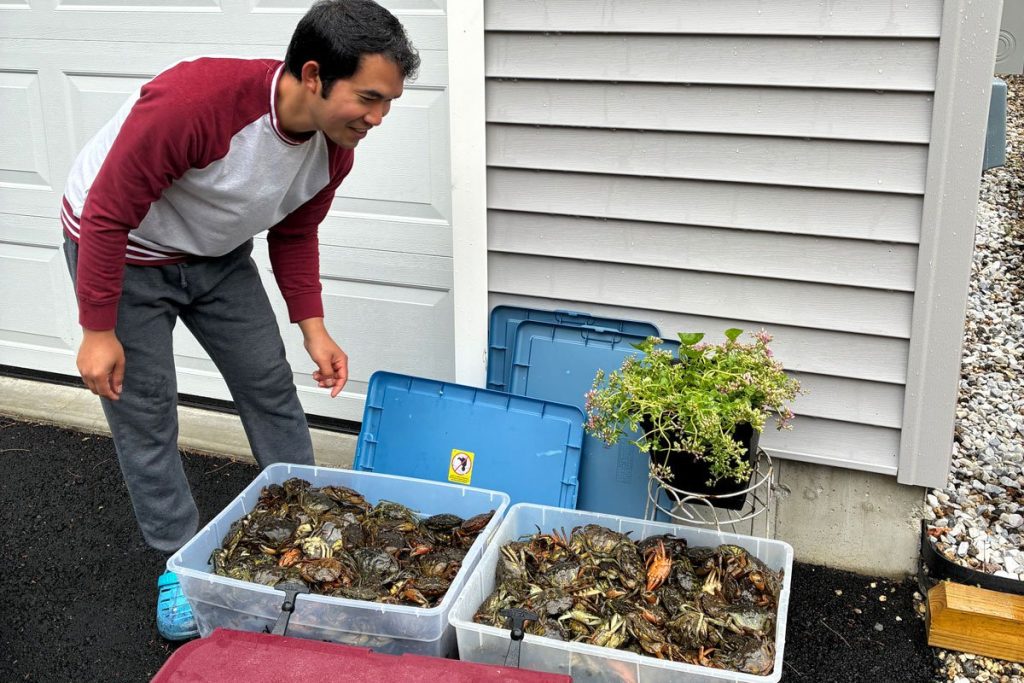
Khmer Maine’s Bunly Uy with European green crabs. (Photo credit: Neil Stanton)
In Cambodia, resourceful farmers and cooks turned a crop-damaging pest—the rice-paddy crab —into a culinary staple. Uy’s new home is dealing with its own nuisance crustacean: the European green crab, a voracious invasive predator that has taken a bite out of Maine’s critical fisheries by feeding on soft-shell clams and juvenile lobsters. Green crabs have also contributed to steep declines in eelgrass biomass in the Gulf of Maine by damaging rhizomes and young plants as they burrow for shelter and dig for prey.
All this is happening as the Gulf of Maine warms faster than 99 percent of the world’s oceans, creating increasingly hospitable conditions for the green crab to proliferate. In this ecological crisis, Uy and his colleagues saw opportunity.
With help from a U.S. Department of Agriculture (USDA) Business Builder grant, Khmer Maine is preparing to launch its own kdam prai, made from locally harvested green crabs. The project has also connected Maine’s Cambodian community with GreenCrab.org, a nonprofit leading a regional effort to mitigate the crabs’ environmental impact by turning them into a food source.
Gobbling up green crabs is part of a broader movement that has also put lionfish, feral pigs, kudzu, and Asian carp on dinner plates and restaurant menus to stanch the spread of invasive species. Joe Roman, a conservation biologist who developed the concept of invasivorism 25 years ago, describes it as “a form of biological control” with the human appetite as the agent of change.
For Marpheen Chann, who founded Khmer Maine in 2018 to unite his community, salted crab offers a way to share a meaningful message while helping to address the green crab problem.
“We are showing how immigrants impact our communities and contribute to culture, economy, and ecology,” Chann says.

2-Khmer Maine brings in community members…. : Khmer Maine’s Bunly Uy (far left) processes European green crabs for kdam prai with Cambodian elders at Portland’s Fork Food Lab. (Photo credit: Mary Parks / GreenCrab.org)
It turns out that Uy and Chann weren’t the first to think of pairing green crabs with Cambodian cuisine. Some community elders have been cooking with them for at least a decade, according to Mary Parks, executive director of GreenCrab.org. But their idea took off after a Cambodian New Year celebration in April 2022 when Khmer Maine organized a one-time crab giveaway, hoping to learn more about how people used—or might use—the crustaceans. In just a few hours, more than 1,200 pounds of crab vanished into the hands and homes of eager Cambodian cooks.
“They hold a reminder of home,” Chann says of green crabs. “Some of the grandmothers, the way they look at these crabs, there’s a light in their eyes. They recognize the shape and size of the crab and exactly what it can be used for.”
“Some of the grandmothers, the way they look at these crabs, there’s a light in their eyes.”
Although feedback from the giveaway suggested the Cambodian community wasn’t a suitable wholesale market for fresh crabs, Chann saw potential in a value-added product—especially one that could make the crabs available through Maine’s long winters, when they hide until spring. Khmer Maine received the USDA grant in 2025, securing around $78,000 to create a salted crab product that could address that need. Last fall, Chann and Uy started developing their recipe with support and guidance from some of the community’s elders.
Sokhuon Ou was eager to help. After nearly a decade away from home, she still misses the salted crab she used to eat with her siblings.
“They are the most delicious food,” she says through an interpreter.















Leave a Comment
Your email address will not be published. Required fields are marked with *