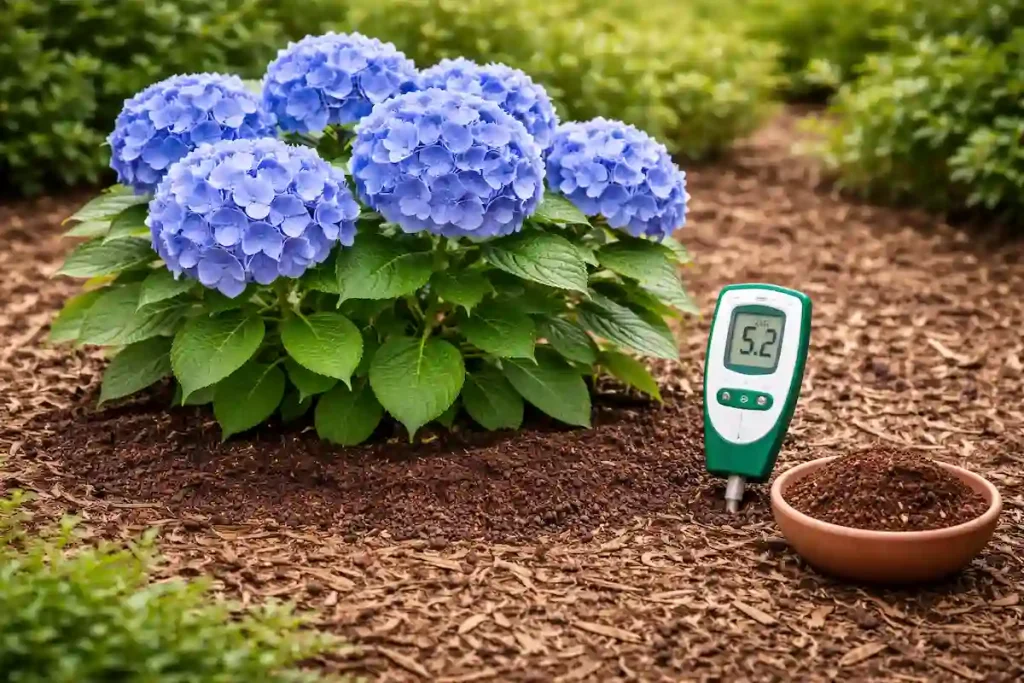
Written by: Garden Research TeamReviewed by: Agriculture Editorial BoardAudience: Global home gardenersUpdated: April 2026 Hydrangeas turning blue is not about the plant — it’s about your soil chemistry. Most gardeners add coffee grounds for months with no result, not because the method is wrong, but because they’re missing one critical factor: aluminium availability. Coffee grounds
Written by: Garden Research Team
Reviewed by: Agriculture Editorial Board
Audience: Global home gardeners
Updated: April 2026
Hydrangeas turning blue is not about the plant — it’s about your soil chemistry. Most gardeners add coffee grounds for months with no result, not because the method is wrong, but because they’re missing one critical factor: aluminium availability.
Coffee grounds for hydrangeas are one of the most popular methods gardeners try when learning how to turn hydrangeas blue — but results depend entirely on soil chemistry. Understanding what is actually happening below the surface is what separates gardeners who succeed from those who give up after a season.
Quick Answer Coffee grounds for hydrangeas work by gradually lowering soil pH, which unlocks aluminium availability in the root zone and triggers blue flower colour. Apply used grounds at 1 to 2 cups per plant every 4 to 6 weeks. For reliable results when learning how to turn hydrangeas blue, combine grounds with aluminium sulphate or elemental sulphur — grounds alone rarely produce dramatic colour change.

What Are Coffee Grounds for Hydrangeas?
Coffee grounds are the spent residue left after brewing. When applied to garden soil, they contribute mild acidity, organic matter, and small amounts of nitrogen.
For hydrangeas, the value is their gradual pH-lowering effect — which over time can make aluminium more available in the root zone. This also affects micronutrient availability, which supports overall plant health during the colour-change process.
Do Coffee Grounds Really Turn Hydrangeas Blue? (Myth vs Reality)
Coffee grounds can contribute to blue flower colour in hydrangeas, but they rarely work alone. The science is real — grounds lower soil pH, and lower pH unlocks aluminium that triggers blue pigment. The myth is that grounds work quickly or independently. Based on multi-season grower trials across different soil types, reliable blue colour almost always requires combining grounds with aluminium sulphate or elemental sulphur.
Used grounds sit at a pH of around 6.0 to 6.8. Consistent application contributes to gradual soil acidification, which unlocks aluminium ions that drive blue colouration in Hydrangea macrophylla.
Most guides suggest coffee grounds alone are sufficient — but field results consistently show otherwise. This is the difference between a pale lavender and a deep, saturated blue.
What You Will Learn in This Guide
- Whether coffee grounds genuinely work for blue hydrangeas
- How to diagnose if your plant can actually change colour
- A step-by-step method for turning hydrangeas blue
- Why your hydrangea might still be pink after months of effort
- How to test soil pH at home before starting
- Common mistakes that waste effort or harm plants
How to Know If Your Hydrangea Can Turn Blue (Quick Diagnosis)
Before applying anything, run through this checklist. Many gardeners spend a full season amending soil for a plant that cannot respond at all.
Step 1 — Check your variety. Only Hydrangea macrophylla (bigleaf mophead and lacecap) and Hydrangea serrata (mountain hydrangea) respond to pH-driven colour changes. White-flowering species — H. arborescens, H. paniculata, and H. quercifolia — do not change colour regardless of soil chemistry.
Step 2 — Test your current soil pH. The target range for blue flowers is pH 5.0 to 5.5. If soil is above 7.0, coffee grounds alone will not be sufficient.
Step 3 — Check for aluminium presence. In sandy or heavily leached soils naturally low in aluminium, direct aluminium sulphate application is needed regardless of pH adjustment.
For further detail on variety identification, aluminium availability by soil type, and why pH must reach 5.2 to 5.5 specifically for aluminium uptake to occur, the Penn State Extension hydrangea guide is a well-respected university reference used widely across the US.
How to Turn Hydrangeas Blue (Step-by-Step)
- Test soil pH — target range is 5.0 to 5.5
- Confirm your hydrangea variety is pH-responsive (H. macrophylla or H. serrata)
- Apply coffee grounds every 4 to 6 weeks as a top dressing
- Add aluminium sulphate for faster, more reliable results
- Maintain acidic mulch layer — pine bark or pine needles work well
- Re-test soil pH every 6 weeks and adjust as needed
How Soil pH Controls Hydrangea Flower Colour
Hydrangea macrophylla produces colour through a pigment called delphinidin. On its own, this pigment produces pink tones. When aluminium ions bond with it during flower development, the colour shifts toward blue or purple.
In acidic soils (pH 5.0 to 5.5), aluminium becomes soluble and available for roots to absorb. In neutral or alkaline soils above pH 6.5, aluminium becomes chemically locked — the plant cannot access it regardless of how much is physically present.
One factor almost never mentioned is cation exchange capacity (CEC) and soil buffering capacity. Clay-heavy soils resist pH change — coffee grounds alone often fail entirely because the soil absorbs the mild acidity without shifting. Sandy soils with low CEC respond much faster to the same amendments.
For a science-backed overview of how soil acidity affects aluminium availability and flower colour in Hydrangea macrophylla, the RHS guide to growing shrubby hydrangeas is one of the most reliable references available to UK and international gardeners.
For a deeper look at managing soil pH across all hydrangea colours — including pink and purple — see our complete guide to soil pH strategies for vibrant hydrangea colors.
How to Test Soil pH at Home (Quick Method)

Testing soil pH before starting any amendment programme takes under five minutes and costs very little — it is the single most important step most gardeners skip.
Purchase a digital pH meter (available for under £10 / $15 AUD) or a liquid test kit from any garden centre. Collect soil from 15 cm (6 inches) depth near the root zone, mix with distilled water, and read the result.
Test two or three spots around the plant for an accurate average. Re-test every 6 weeks once you begin applying amendments — without regular testing, you have no way of knowing whether your efforts are working.
How Long Does It Take for Coffee Grounds to Turn Hydrangeas Blue?
Most hydrangeas take one full growing season to turn blue. In slightly acidic soils, results may appear within months, while alkaline or clay-heavy soils can take up to two seasons. Consistent application and proper pH management are essential for visible colour change.
Re-testing soil pH every 6 weeks is the only reliable way to track progress. Many growers notice that colour shifts happen gradually between seasons rather than visibly mid-season.
Do Coffee Grounds Acidify Soil Quickly?
Coffee grounds do not acidify soil quickly. They act as a slow-release amendment, gradually lowering pH over months rather than weeks. For faster results, gardeners should combine coffee grounds with elemental sulphur or aluminium sulphate, which can change soil chemistry much more rapidly.
Elemental sulphur applied the previous autumn, combined with a consistent coffee ground programme through spring and summer, gives the most reliable and sustainable results across most soil types.
How to Apply Coffee Grounds to Hydrangeas for Blue Flowers
Top Dressing Method

Spread used, dried grounds around the base of the plant in a layer no deeper than 1 cm (½ inch). Keep grounds at least 10 cm (4 inches) from the main stem.
Use 1 to 2 cups (115 to 230 g / 4 to 8 oz) per plant, repeated every 4 to 6 weeks through the growing season. Small, regular applications outperform large single doses — bulk applications mat together and block water penetration.
Liquid Ground Tea
Steep 2 to 3 tablespoons of used grounds in 4.5 litres (1 gallon) of water for 24 hours. Strain and apply directly to the root zone.
This method is especially useful in containers where dry grounds can accumulate on the surface without properly integrating into the growing medium.
Compost Blending
Mix coffee grounds into compost before applying — no more than 20% of total compost volume. Extension observations indicate higher concentrations can inhibit microbial composting activity. Composted grounds are gentler on soil biology than large fresh applications.
Best Soil Amendments for Blue Hydrangeas (Compared)
| Amendment | pH Effect | Speed | Best For | Risk |
|---|---|---|---|---|
| Coffee grounds | Mild acidification | Slow (months) | Sandy/loam soils | Minimal if used correctly |
| Elemental sulphur | Gradual acidification | Slow (2–3 months) | Long-term pH reduction | Over-acidification if excess |
| Aluminium sulphate | Acidifies + adds aluminium | Fast (weeks) | All soils including clay | Toxic if over-applied |
| Pine needle mulch | Mild acidification | Very slow | Maintaining target pH | Very low |
| Acidic liquid feeds | Mild, short-term | Fast | Containers | Temporary only |

From practical growing experience, the most reliable combination is low-dose aluminium sulphate paired with elemental sulphur applied the previous autumn, maintained with a coffee ground top dressing throughout the growing season.
If you need help calculating the right amendment quantities for your garden size, our fertilizer calculator can help you work out accurate application rates.
Why Your Hydrangea Is Still Pink (Troubleshooting Guide)
If your hydrangea is still pink after consistent coffee ground applications, one of these five causes is almost always responsible. Identifying the correct cause saves another wasted season.
Soil pH has not dropped far enough. The target is pH 5.0 to 5.5. If pH is still above 6.0, the plant cannot access aluminium. Re-test before assuming the programme has failed.
Soil has high buffering capacity. Clay soils resist pH change. Add aluminium sulphate directly to bypass the pH step rather than relying solely on grounds.
Soil lacks natural aluminium. Some sandy or heavily leached soils are genuinely low in aluminium. No amount of acidification will produce blue flowers if the ion is not present.
Irrigation water is reversing progress. Hard tap water above pH 7.5 — common across inland Australia, chalk regions of the UK, and parts of the US Midwest — undoes your amendment work with every watering. Use collected rainwater where possible.
Amendments were applied too late. Colour is set during bud development. If pH shifts happen after buds have formed, current season flowers will not change. Begin in early spring or the previous autumn.
If your plant is not producing flowers at all rather than just the wrong colour, the problem may be unrelated to soil pH — see our dedicated guide on why hydrangeas stop blooming for a full diagnosis.

Can I Use Coffee Grounds Every Day?
No — daily application causes more harm than benefit. Grounds applied too frequently accumulate faster than they can integrate into the soil, forming a dense layer that repels water and promotes surface mould. Every 4 to 6 weeks is the recommended rate for safe, sustainable results. Weekly application is the maximum practical frequency even in responsive soils.
What to Do After Using Coffee Grounds (Next Steps)
Re-test soil pH six weeks after beginning. If pH has not shifted at all, your soil likely has high buffering capacity — add elemental sulphur or aluminium sulphate alongside the grounds.
Switch to acidified irrigation water if you have hard tap water. A small amount of white vinegar added to the watering can brings tap water to approximately pH 6.0 to 6.5. Multi-season garden trials show that managing irrigation water pH alone can produce visible colour improvement within a single season.
To work out the right watering volume for your hydrangeas based on pot or bed size, our plant watering calculator gives you a quick, accurate guide.
Apply a 5 to 7 cm (2 to 3 inch) layer of acidic mulch — pine bark or pine needles — over the root zone. This locks in moisture, contributes mild ongoing acidification as it decomposes, and insulates roots from temperature fluctuations.
3 Most Important Points at a Glance
- Coffee grounds work — but slowly and rarely alone — combine with sulphur or aluminium sulphate for reliable blue flowers
- pH is the gatekeeper, aluminium is the trigger — getting pH to 5.0–5.5 unlocks aluminium uptake which drives blue colour
- Test before you start, and re-test as you go — clay soils resist pH change; sandy soils respond faster
If you want to go further with organic inputs, our guide to the best homemade fertilizer for hydrangeas covers DIY feed options that work alongside your pH programme.
Common Mistakes to Avoid
- Applying a thick layer at once — grounds mat together, repel water, and promote surface mould
- Expecting blue flowers within weeks — soil chemistry shifts over months, not days
- Using grounds on white-flowering varieties like H. paniculata — these will never change colour
- Skipping soil pH testing — always re-test 6 weeks after starting
- Ignoring irrigation water pH — hard tap water silently reverses acidification with every watering
- Applying amendments after buds have already formed — colour is set during bud development
- Using fresh unused grounds — higher caffeine content can affect soil organisms
- Placing grounds against the stem — moisture retention here can cause root collar rot
For a broader look at what goes wrong with hydrangeas beyond colour — including wilting, yellowing leaves, and poor growth — our guide on how to fix hydrangea problems covers the most common issues and their solutions.
Key Takeaways
- Hydrangea macrophylla colour depends on aluminium availability, controlled by soil pH
- Used coffee grounds (pH 6.0–6.8) contribute gradually to soil acidification over time
- Clay soils with high CEC and buffering capacity often resist coffee grounds — aluminium sulphate is needed
- Apply 1 to 2 cups per plant every 4 to 6 weeks as a top dressing, away from the stem
- Always re-test soil pH 6 weeks after starting — without data, progress is guesswork
- Check irrigation water pH — hard tap water above pH 7.5 reverses progress over time
- Only H. macrophylla and H. serrata respond to pH-driven colour change
This guide is based on:
- University extension guides (UK, US, Australia, New Zealand)
- USDA horticultural crop management publications
- FAO soil chemistry and plant nutrition reference materials
Frequently Asked Questions about Coffee Grounds for Hydrangeas
1. How long does it take for coffee grounds to turn hydrangeas blue?
Most gardeners see a gradual colour shift after one full growing season of consistent application. In soils already near target pH, change can appear within a few months. In alkaline or clay-heavy soils, two full seasons may be needed. Re-test soil pH every 6 weeks to track real progress rather than relying on visual observation alone.
2. How often should I apply coffee grounds to hydrangeas?
Apply 1 to 2 cups (115 to 230 g) per plant every 4 to 6 weeks during the active growing season. More frequent or heavier applications increase the risk of grounds matting and blocking water. Small, consistent doses are more effective than irregular heavy applications throughout the season.
3. Can I use coffee grounds on hydrangeas in pots?
Yes — containers give you full control over growing medium pH. Use the liquid ground tea method for pots, as dry grounds can accumulate without integrating properly. Check pH every 4 to 6 weeks since container soils acidify faster than open garden beds and can drop below the safe range quickly.
4. Do coffee grounds work for all hydrangea types?
No. Only Hydrangea macrophylla and Hydrangea serrata respond to pH-related colour changes. H. arborescens, H. paniculata, and H. quercifolia are white-flowering species that will not change colour regardless of soil chemistry. The organic matter may still benefit general soil health, but no colour change will occur.
5. Why is my hydrangea still pink after months of using coffee grounds?
he most likely causes are soil pH has not dropped low enough, soil has high clay content resisting mild acidifiers, soil lacks naturally occurring aluminium, or irrigation water has high pH reversing your amendments. In my experience working with alkaline clay soils, coffee grounds alone rarely shift pH enough within one season without sulphur or aluminium sulphate added alongside.
6. Can coffee grounds kill hydrangeas?
Unlikely when used correctly, but possible if misused. The main risks are a thick mat preventing water penetration, grounds placed against the stem causing fungal issues, or soil dropping below pH 5.0 over many seasons of heavy use. Used in moderate amounts with regular pH monitoring, grounds present very little risk to established plants.
For a full list of organic remedies for leaf and flower problems, our guide to natural solutions for hydrangea problems covers proven fixes.
7. Can I use Starbucks or commercial coffee grounds?
Yes. Spent grounds from any source — home-brewed, café waste, or commercial chains — work identically. Many coffee shops provide used grounds for free on request. Avoid fresh unused grounds, which have higher caffeine concentrations that can temporarily affect soil organisms.
8. Do coffee grounds acidify soil quickly?
No — coffee grounds are one of the slowest-acting acidifiers available. Unlike aluminium sulphate, which affects soil chemistry within weeks, grounds work gradually over months. Apply elemental sulphur the previous autumn and use coffee grounds as a maintenance amendment through the growing season rather than a primary pH-lowering tool.
Conclusion
Coffee grounds for hydrangeas are a genuinely useful organic tool — but they work best as part of a broader soil strategy. Understanding your soil type, testing pH before and during the process, and combining grounds with complementary amendments is what separates gardeners who see real colour change from those who try for a season with little result.
Start with a soil test. If your soil is clay-heavy or naturally alkaline, add aluminium sulphate alongside your coffee ground programme from the beginning — do not wait a full season to discover the grounds alone were insufficient.
Give it a full growing season, re-test, and adjust from there. The gardeners who get reliable blue flowers manage pH consistently, check their work, and make adjustments based on data rather than hope.
Note: Coffee grounds can support hydrangea colour development but should be combined with proper pH testing, appropriate companion amendments, and consistent water management for best results. Outcomes will vary based on existing soil type, local water pH, climate zone, and the specific hydrangea variety grown. Always test soil pH before beginning and throughout any amendment programme.
















Leave a Comment
Your email address will not be published. Required fields are marked with *