Students in the course cook from-scratch meals for the entire school (K through 12), located just outside the Siletz Reservation, in central Oregon. They also run a food truck, which is named YA-TR’EE-YAN (“a gathering of people around food” or “feast” in Dee-ni) and offers free meals to students and tribal members during the summer.
Students in the course cook from-scratch meals for the entire school (K through 12), located just outside the Siletz Reservation, in central Oregon. They also run a food truck, which is named YA-TR’EE-YAN (“a gathering of people around food” or “feast” in Dee-ni) and offers free meals to students and tribal members during the summer. They serve some recipes from my cookbook, too, with Native ingredients like venison, elk, salmon, and sablefish.
I’ve heard Native foods described as the first cuisine of the Americas and the last to be discovered. All these different Asian and European cultures are represented in the U.S., but until recently people wouldn’t even say there is a Native cuisine. Coming up, I didn’t have any Native chefs to look up. Telling that story, at the restaurant and to my students, has been something I’ve really tried to do.
I was raised on the Siletz reservation in central Oregon by my grandmother and grandfather. I enjoyed growing up in a small town. It felt safe; you knew everyone; there was no traffic. There was the forest where you could run around a little bit, and the river for fishing, and this place called the play shed, where I played basketball. You got to experience different sports because there weren’t a lot of kids—they needed everybody to make a team.

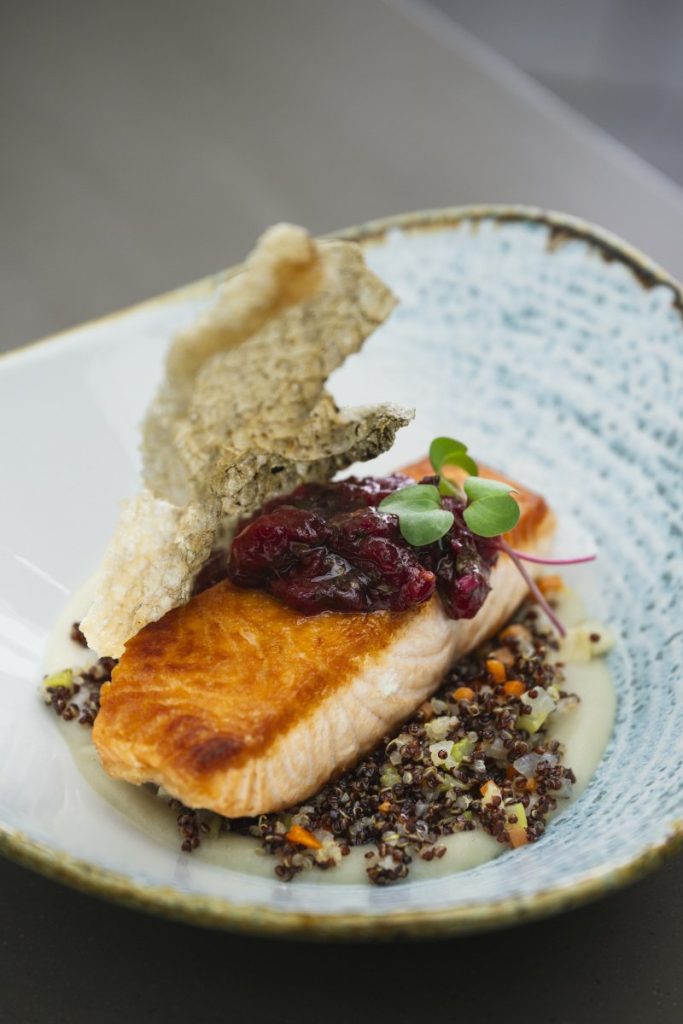
One of Strong’s signature dishes at JORY: Pan-roasted Skuna Bay King salmon with a salmon skin chip, set on sunchoke purée and quinoa and topped with cranberry relish and radish microgreens. (Photo credit: Kari Rowe)
My grandma would tell me stories about the history of our family and tribe. There was a time when we were a recognized tribe. Then, from the 1950s to the 1960s, the U.S. government eliminated federal status for tribes. We lost all federal recognition, access to land, resources, benefits. We call that the “termination” period.
What we have now in Siletz is a mere fraction of what our original land was. We moved here from our ancestral homelands, which are primarily from Southern Oregon into Northern California.
Termination was a tough time for our tribe, but they continued to fight to be recognized as a sovereign nation again and have land to create a home that would be ours for generations. Many tribal leaders made trips to Washington, D.C., to speak in front of Congress on our behalf, including my grandfather, who was on our tribal council as well as being a war veteran. In 1977, we regained federal status.
I was fortunate because as I grew up, the tribe started do more culturally important activities that we hadn’t done during termination. Our community started what we call “culture camp” that we still do every year over a weekend. They were teaching the youth things like basketry making and preparing eels to eat. My grandma would tell stories about teaching herself everything—like her amazing beadwork —and was a big part of making sure I went to that camp to learn about our culture.
“Friends and family knew there was always some kind of meal happening at the Strong house.”
My grandfather passed away when I was ten, but growing up, my grandmother was working and he was retired, so I originally started cooking for him. It was basic stuff that I learned from my grandmother—who cooked everything from scratch for us—and I learned I had a love for being in the kitchen.
I got into fishing as a young teenager. The Siletz River runs through the town and reservation, then it joins the ocean in the Siletz Bay. Growing up, I’d see salmon and steelhead trout spawning in the river.
My family was connected with seafood. My uncle was known for his smoked salmon—he would barter with smoked salmon like currency. He’d dig for clams and mussels, too. My other relatives worked in seafood processing. They would bring my grandma salmon heads. She would boil them and eat all the parts—the eyeballs, the cheeks. Later, in my first job out of culinary school, I did a lot of seafood butchery, and we would break down all of our salmon, and I’d bring the heads to her as gifts.
I’ve been asked quite a bit throughout my career about my grandma’s cooking. Her time was so much about survival. It was being taken from your homelands and away from your native foods. Growing up toward the end of that in the ‘80s, we were still on commodity foods—the flour and fats and sugars that were given to us. One of my first early times helping her in the kitchen was making noodles from scratch for chicken noodle soup.
Friends and family knew there was always some kind of meal happening at the Strong house. It was never just us eating by ourselves—it was always people coming over. I had this connection that food equates to taking care of other people, it gives you a sense of home and community.
My Culinary Influences
My first job was in high school at a fish-and-chips place in Newport, along the coast, 20 minutes away. It was a husband and wife who owned it, and they were mentors for me. He would go down to the boats on the bay front and get fresh fish, bring it back, and teach us how to fillet it.
I learned to appreciate fresh products and also the basics of hospitality, like cleanliness and multitasking, and how to interact with guests and the importance of being a strong player to support the team.
Afterwards, I enrolled in a two-year hands-on culinary program at Lane Community College in Eugene, and then at a local restaurant. That chef asked me to do a dish that might speak more to my culture.
I thought of fry bread, which was such a big part of our culture, but also came out of survival. My chef was Jewish, so I made a play off of lox and bagel with fry bread and cold-smoked cured salmon lox. That was probably the first-ever dish highlighting some part of my culture. That’s when I started to do what I do now every day.
After eight years at the restaurant, I started to get itchy. I wanted to try something else. I got an offer from the Phonecian Resort, near Phoenix, that had over 1,200 employees—more staff than people who lived in the town I came from. Arizona was the opposite of Oregon. Here, it’s beautiful and green and wet. There, it was dry and sunny every day. It was completely different from what I was used to. It was overwhelming, but I grew quickly there because I was like a sponge, absorbing everything.
I learned about the foods from the other beautiful tribes around there—the Navajo, Hopi, Gila River, Tohono O’odham. They’re all so different, and they’re all based off of place. Southwest foods include so many different chiles, beans, and corn—all Native foods. It was just so clear to see how these foods have sustained people for generations.

Students at the Siletz Valley School culinary program butchering local albacore tuna. (Photo credit: Rachelle Hacmac)
After many years of working in Arizona—including at the Sheraton Grand at Wild Horse Pass, on the Gila River Reservation, and KAI, which is influenced by the food of the Akimel O’odham and Piipaash peoples—I ultimately came back to the Northwest to be close to family. Now, at The Allison in Newberg, I get to highlight Native foods in the kitchen and garden. I really love that—it’s my culture and home, and it’s nice to be able to share all the great things that come from here.
My role as a chef is about taking care of others, nourishing people. I’ve always felt like my part in this ecosystem is to support the farmers, the fishermen—to put money back into community.
If you’re getting any kind of tribal foods or just even local foods, usually they’re not really set up with infrastructure, so it takes extra effort on your part. At JORY, the fine-dining restaurant at The Allison, we use a lot of local.














Leave a Comment
Your email address will not be published. Required fields are marked with *