Why “Less Harm” Isn’t Enough Anymore: For years, sustainability has been pitched like a diet plan for business: reduce emissions, reduce waste, reduce water use, reduce risk. And to be fair, all of that still matters. A lot. But you can feel the conversation shifting. More companies are asking a question that’s a little awkward,
Why “Less Harm” Isn’t Enough Anymore:
For years, sustainability has been pitched like a diet plan for business: reduce emissions, reduce waste, reduce water use, reduce risk. And to be fair, all of that still matters. A lot.
But you can feel the conversation shifting. More companies are asking a question that’s a little awkward, and kind of necessary: if we’re still damaging the system, just more slowly, is that actually a win? This question is helping drive the rise of the regenerative economy across industries worldwide.
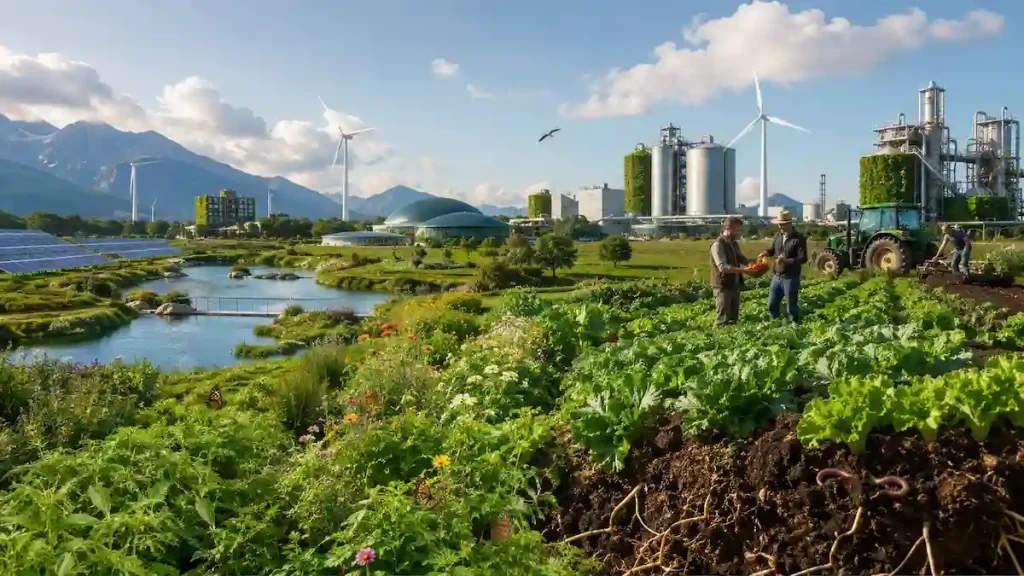
That’s basically where the regenerative economy comes in. Instead of only trying to shrink harm, it aims to rebuild what’s been worn down, healthier soils, stronger biodiversity, sturdier communities, supply chains that leave ecosystems better than they found them.
Many of these goals are already being implemented through proven regenerative agriculture practices that focus on restoring soil health, increasing biodiversity, and improving long-term farm resilience.

It’s a move from “how do we leave a smaller footprint?” to “how do we help the place recover while we’re here?” And yes, the business case is getting louder. The World Economic Forum has estimated that 15 nature-positive transitions could generate up to US$10.1 trillion in annual business value and create 395 million jobs by 2030.
Why Regeneration Is Suddenly a Boardroom Topic
Part of this is values, sure. But a big chunk of the urgency is financial.
Nature props up an enormous slice of the global economy, think water availability, soil fertility, pollination, climate stability, raw materials, the basics that make everything else possible. And yet we still spend far more money funding activities that degrade those systems than protecting them.

UNEP’s 2026 State of Finance for Nature report put it bluntly: for every US$1 invested in protecting nature, around US$30 goes to activities that damage it. The same report estimated US$7.3 trillion flowed into nature-negative activities in 2023. Once you see numbers like that, “regeneration” stops sounding like a niche environmental idea and starts looking like risk management, for procurement, farm programs, product design, supply chain planning, all of it. Companies are trying to protect the inputs they rely on, even if they don’t always say it in those exact words.
ICL Group is one example of how an agriculture-linked business can fit into this conversation without pretending it has a magic wand.
In a regenerative framing, crop nutrition isn’t just, “Here’s fertilizer.” It’s more like, “How do we help growers use nutrients more precisely, protect yields, and get more out of finite land and mineral resources?”
ICL talks about work across agriculture, food, and industrial solutions, including big challenges like food security and access to essential minerals, plus specialty agriculture, potash, phosphate, and other mineral resources. Now, it’s worth saying out loud, because marketing can get a little enthusiastic here: no single product makes a farm “regenerative.”
Still, nutrient management, specialty fertilizers, AgTech, and responsible mineral use absolutely belong in the mix if the goal is productive farming with less avoidable pressure on ecosystems.
Build Food System Partnerships That Start on the Farm and Actually Stick
Danone shows something that’s easy to miss if you only think in terms of targets and spreadsheets: regeneration often starts with relationships, not checklists.
Its regenerative agriculture approach focuses on protecting soils, supporting farmers, and promoting animal welfare, while linking farm resilience with climate resilience and business resilience. That connection matters because food companies depend on living systems, and living systems don’t behave like machines.

Healthy soil can shift water retention, drought tolerance, nutrient cycling, and long-term productivity. And farmer livelihoods matter just as much, because changing practices usually means training, financing, technical support, and, honestly, trust that the buyer won’t vanish after a one-year pilot.
Understanding key soil health indicators can help farmers measure whether regenerative practices are delivering meaningful improvements over time
So the real lesson is pretty simple: regeneration rarely works as a single procurement box you tick. It behaves more like a partnership model, where environmental outcomes have to line up with farm economics, animal health, and the long-term stability of ingredient supply.
Make Regenerative Sourcing Specific Enough to Measure
Nestlé is a useful case study here, mostly because it shows how “regenerative” gets more believable when it turns into a measurable sourcing commitment.
The company says it aims for 50% of its key ingredients to come from farmers adopting regenerative agriculture practices by 2030.
Targets like that help because the word regenerative can get vague fast. Different crops, regions, and farm types need different approaches, so comparisons can get messy. The hard part, and where programs often succeed or fail, is measurement. You need to know what practices are actually being adopted, what outcomes are changing, and whether farmers are financially better off while they transition.
Once this scales, regenerative sourcing stops being a side project with a nice slide deck. It starts acting like an operating model for managing supply risk, ingredient quality, climate exposure, and the long-term health of the landscapes on which the food production depends.
Use Purchasing Power to Move Beyond Pilots and Into Landscapes
Unilever shows what happens when a big buyer tries to push regeneration past the “cool pilot program” stage.
By the end of 2025, the company reported implementing regenerative agriculture practices across 254,000 hectares since 2021, through 34 programs in 17 countries.
The number is impressive, but the bigger value is coordination. Large companies can line up suppliers, farmers, agronomists, and internal commercial teams around shared outcomes, soil health, biodiversity, water resilience, and, where it makes sense, less input pressure.
Purchasing power can lock in extractive systems, or it can help normalize better land stewardship. If the regenerative economy is going to become mainstream, not just a niche concept, it probably depends on the second option, contracts, incentives, and support that make better practices financially workable at a landscape level.
Bring Regeneration Into Materials and Apparel, Not Just Food
Patagonia widens the lens by pushing regenerative thinking into fiber and materials sourcing, not only food.
The company supports Regenerative Organic Certified cotton and points to practices like low or no tilling and composting to build healthier soil.
This matters because regeneration doesn’t stop at edible crops. Cotton, wool, timber, rubber, leather, and other bio-based materials all come from landscapes shaped by soil, water, biodiversity, labor conditions, and climate risk.
When apparel brands lean into regeneration, they start asking different questions, and those questions change behavior. How was the fiber grown? What happened to the soil over time? Were farmers treated fairly? What kind of farming system does this product reward? That shift can turn sourcing into something closer to ecological repair, instead of a hidden environmental bill that shows up later.
Put Outcomes First, and Don’t Hide Behind Labels
General Mills highlights a reality that a lot of companies are bumping into: labels matter less than results you can actually defend.
The company says it’s working to advance regenerative agriculture on 1 million acres of farmland by 2030, tied to broader goals around climate, water, and agricultural resilience.
That outcomes-first stance matters because regenerative practices aren’t one-size-fits-all. Cover crops, reduced tillage, crop rotation, livestock integration, nutrient management, habitat restoration, all of these can fit under the umbrella. But the right mix depends on soil type, climate, crop, farm economics, and local know-how.
If you’re leading this work, the implication is pretty straightforward: judge programs by credible indicators. Soil health, water performance, biodiversity signals, farmer resilience, emissions trends, and supply reliability. Without that discipline, regeneration risks becoming a branding term that sounds nice and proves very little.
Design Industrial Systems That Behave More Like Ecosystems
Interface is a good reminder that regenerative thinking isn’t only an agriculture story.
The company moved from its earlier Mission Zero agenda to Climate Take Back, with an ambition to become carbon negative by 2040 and to develop processes and products with a positive impact.

That matters because you can’t build a regenerative economy on farms alone. Manufacturing, construction, materials, and logistics all need models that reduce waste, circulate resources, and take cues from ecosystems, which create value without piling up permanent waste streams.
In practice, that might look like designing products for reuse, choosing lower-impact materials, storing carbon where possible, and rethinking factories as systems that interact with their surrounding environment, not sealed boxes that only consume and produce.
The bigger point is that regeneration isn’t a sector; it’s a design principle you can apply anywhere a company transforms resources into products.
Conclusion: Regeneration Is Becoming a Business Strategy
The rise of the regenerative economy signals a shift in what responsible business is expected to deliver. Reducing harm remains essential, but companies are increasingly being asked to strengthen the systems they depend on, from soils and watersheds to supply chains, communities, and critical natural resources.
The organizations leading this transition are not treating regeneration as a marketing concept. They are embedding it into sourcing decisions, agricultural programs, product design, manufacturing processes, and long-term risk management strategies. The goal is not simply to sustain existing systems, but to improve their capacity to support future growth.
As environmental pressures, resource constraints, and supply chain risks continue to intensify, regeneration is likely to become less of a niche sustainability concept and more of a practical business discipline. The companies that learn how to create value while helping restore the natural systems behind that value may ultimately be the ones best positioned for long-term resilience and growth.















Leave a Comment
Your email address will not be published. Required fields are marked with *