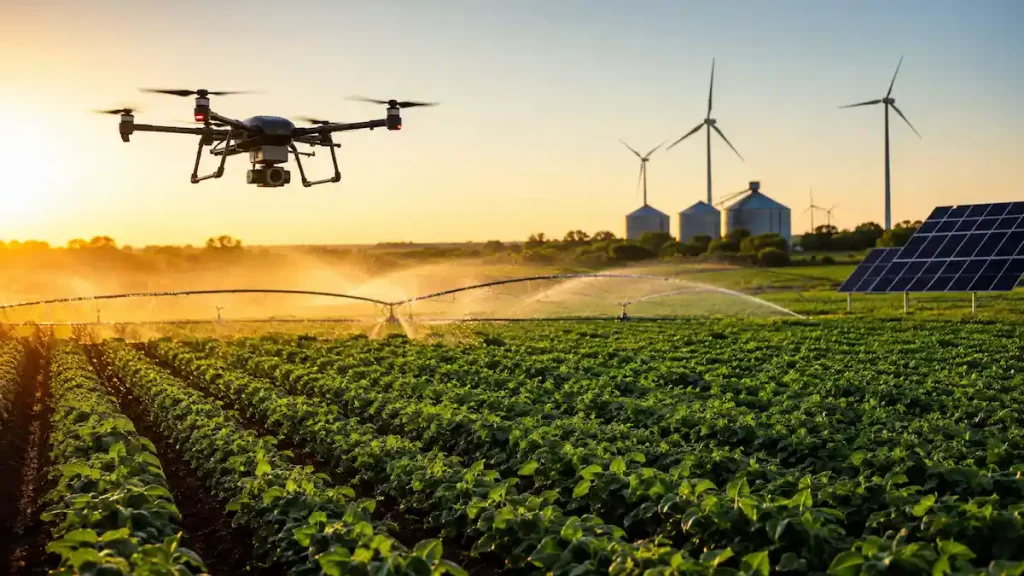
You can feel the squeeze now, not as a distant sustainability talking point, but as a real operating constraint. Producing more with less is becoming the reality for Agriculture, industry, and food production are moving into a phase where growth has to come from using what we already have more intelligently, not from spreading out
You can feel the squeeze now, not as a distant sustainability talking point, but as a real operating constraint. Producing more with less is becoming the reality for Agriculture, industry, and food production are moving into a phase where growth has to come from using what we already have more intelligently, not from spreading out endlessly.
Land does not magically expand. Water is under stress in plenty of regions. Energy costs swing, sometimes violently. Raw materials are increasingly exposed to supply shocks and price volatility. FAO’s 2025 land and water assessment puts it bluntly: as the global population heads toward 10 billion by 2050, agriculture needs to produce 50% more food, feed, and fibre than in 2012, and do it alongside 25% more freshwater.
It also warns that simply expanding agricultural areas is no longer the default option. So resource efficiency stops being a theme for annual reports and starts looking like the day-to-day discipline behind food security, industrial continuity, and long-term competitiveness.
Why efficiency now looks a lot like resilience
This pressure is not confined to the farm gate. UNEP’s Global Resources Outlook 2024 reports that natural resource extraction has tripled over the last five decades and, without urgent action, could rise another 60% by 2060. It also links extraction and processing to large shares of climate impacts, air pollution, biodiversity loss, and water stress.
For business leaders, that shifts the question in a pretty practical way. It is not just: Does this operation look “sustainable” on paper? It is: Can this operation keep running when inputs get expensive, supply chains wobble, regulations tighten, and customers start asking sharper questions? In that world, resilience often means getting more value out of every unit of land, water, nutrient, molecule, kilowatt, and tonne of material, because you may not get a second chance to source them cheaply or reliably.
1. Crop nutrition that wastes less
ICL Group is a good example of how resource efficiency can start with something as basic and as hard as matching inputs to biological demand. In crop nutrition, the goal is not “more fertilizer.” It is fertilizer applied in a way that actually lines up with the plant growth cycle, soil conditions, and what the farm can afford.
The company describes controlled-release fertilizers designed to optimize nutrient availability across the plant growth cycle with a one-time application. It also points to innovation priorities like increased nutrient use efficiency, biodegradable coatings for controlled-release fertilizers, enhanced-efficiency fertilizers, and farmer-centric digital agriculture solutions.
The value here is fairly straightforward. When nutrients are better timed and better targeted, agronomic programs can get cleaner and simpler, with fewer unnecessary applications and less time spent repeating passes in the field.
And, honestly, in a constrained world, fertilizer efficiency is not some niche technical detail. It can be a resilience lever for growers juggling cost pressures, weather uncertainty, labor availability, and rising food demand all at once.

2. Precision farming that turns data into input control
John Deere shows why efficiency increasingly depends on the quality of operational data, not just the horsepower of the machine. Its precision agriculture tools focus on connectivity, farm data management, application accuracy, variable-rate application, guidance, and field and water management.
Learn more about the principles and benefits of precision agriculture and how data-driven farming helps optimize inputs while improving productivity.
That matters because a lot of losses come from tiny mismatches repeated over huge acreage. Seed placement that is slightly off. Fertilizer applied uniformly, even though the field is not uniform. Fuel burned through extra passes. Irrigation that is “good enough” at the whole-field level, but sloppy at the zone level.
Effective irrigation management can help farmers reduce water waste while ensuring crops receive the right amount of moisture at the right time.
Deere’s systems are designed to leverage data and equipment upgrades to improve application rates, input placement, fuel economy, and land stewardship. The bigger lesson for producers is that resilience does not always require ripping everything out and starting over. Often it comes from making existing machinery, fields, and decisions more precise, so waste drops while productivity stays protected, even when margins get thin.

3. Nutrient decisions that follow the crop, not the calendar
Yara International reflects a shift that many agronomists have been pushing for years, moving away from calendar-based fertilizer decisions and toward crop-responsive nutrient management. Its Atfarm platform uses satellite imagery for remote crop monitoring, flags growth differences within fields, supports in-season nitrogen recommendations, and creates nitrogen variable-rate application maps.
This approach matters because fields are rarely uniform in real life. Even within the same farm, soil types, drainage, compaction, and microclimates can vary enough that the crop does not need nutrients at the same moment, or at the same rate, across every hectare. A tool that highlights biomass variation and supports more precise nitrogen planning can help growers and advisers base decisions on what appears to be happening in the crop, rather than leaning only on historical averages and habit.
The resource-efficiency point is practical. When nutrient decisions track crop status more closely, fertilizer can be directed where it actually does the most good, improving the relationship between input cost, agronomic performance, and environmental stewardship.
4. Input supply chains that build productivity into operations
Nutrien brings resource efficiency into a layer that is easy to forget until it breaks, the upstream system that mines, manufactures, moves, and sells crop inputs. Fertilizer and crop-input systems need resilience not only in the field, but also in extraction, processing, logistics, retail agronomy, and inventory planning.
The company reported that in 2025 it mined 49% of its potash ore tonnes using automation, more than double its 2023 level, and linked that to efficiency and its low-cost position. The reminder here is useful. “Producing more with less” applies upstream as much as downstream. Automation, reliability improvements, cost discipline, and more efficient extraction can affect how consistently essential inputs reach farms.
From a grower’s point of view, the sustainability conversation often begins at application. From a food-system point of view, it also depends on whether the input supply chain can keep nutrients available, affordable, and less exposed to bottlenecks when the system is under strain.
5. Energy management as a resource-efficiency operating system
Schneider Electric shows how energy efficiency is becoming as much a data problem as an engineering problem. Its EcoStruxure Resource Advisor is described as a cloud-based platform that aggregates cross-enterprise energy and sustainability information, helping organizations collect, analyze, automate, and centralize data for better operational decisions.
That matters because many facilities already have “hidden” efficiency opportunities; they are just buried in fragmented utility bills, disconnected equipment data, procurement records, and site-level reporting. When those streams stay separate, energy stays stuck as a cost line. It is paid, complained about, and moved on from, rather than managed.
A centralized system can help teams see where consumption patterns, procurement choices, and emissions data intersect. The resilience lesson is pretty simple: you cannot reduce what you cannot see. Energy productivity improves when measurement and accountability move from an annual reporting exercise into the weekly and sometimes daily rhythm of operations.
6. Water efficiency as a license to keep growing
Ecolab highlights why water is becoming one of the hardest constraints on industrial and food-system growth. Its 2025 Growth and Impact Report states that its work with customers helped conserve 245 billion gallons of water, and its water programs are positioned around protecting vital resources, advancing water stewardship, and supporting customer performance.
Water efficiency matters because drought risk, groundwater depletion, discharge requirements, and community concerns can turn water from a background utility into a direct business risk. In sectors like food processing, manufacturing, hospitality, healthcare, and high-tech production, water quality and availability are tied closely to continuity. If water is unreliable, production is unreliable; it is that simple.
So the resource-efficiency imperative is not just “use less water” as a slogan. It is understanding where water creates value, where it gets wasted, and where reuse, monitoring, treatment, or process changes can reduce exposure to scarcity.

7. Food systems that reduce waste from farm to package
Nestlé shows how quickly resource efficiency becomes complicated once your business stretches across farms, factories, packaging, logistics, retailers, and consumers. Its 2024 Creating Shared Value publication discusses regenerative agriculture, water stewardship, packaging reduction, recyclable or reusable design, recycled content, lighter packaging, and efforts to reduce reliance on difficult-to-recycle materials.
That range matters because food waste and material waste sometimes pull in different directions. Packaging protects quality and shelf life, which can reduce food waste, but packaging also needs to be designed for circularity and material efficiency. There is a balancing act here, and it is not always neat.
The broader reality in food is that producing more with less is rarely one intervention. It is a portfolio of choices about soil health, farmer support, water use, sourcing standards, packaging formats, recycling infrastructure, and, whether we like it or not, consumer behavior. The most resilient food systems are likely to be the ones that reduce waste across the chain, not just at the point of production.

The next decade belongs to resource-smart operators
The “produce more value while wasting less” message is easy to say and hard to execute. It also does not mean every business needs the same technology stack or the same sustainability roadmap. A farm may need better nutrient timing. A factory may need better energy visibility. A processor may need water reuse and smarter monitoring. A food brand may need better packaging choices and tighter sourcing standards.
What connects them is a strategic shift. Resilience is no longer just the ability to bounce back after disruption. It is the ability to run with fewer weak points before disruption hits.
Organizations that act now are likely to be better positioned to handle scarcity, cost pressure, regulation, and customer expectations. The path forward is not glamorous, but it is clear: measure what matters, cut what is wasted, and build systems that keep delivering when resources are constrained.















Leave a Comment
Your email address will not be published. Required fields are marked with *