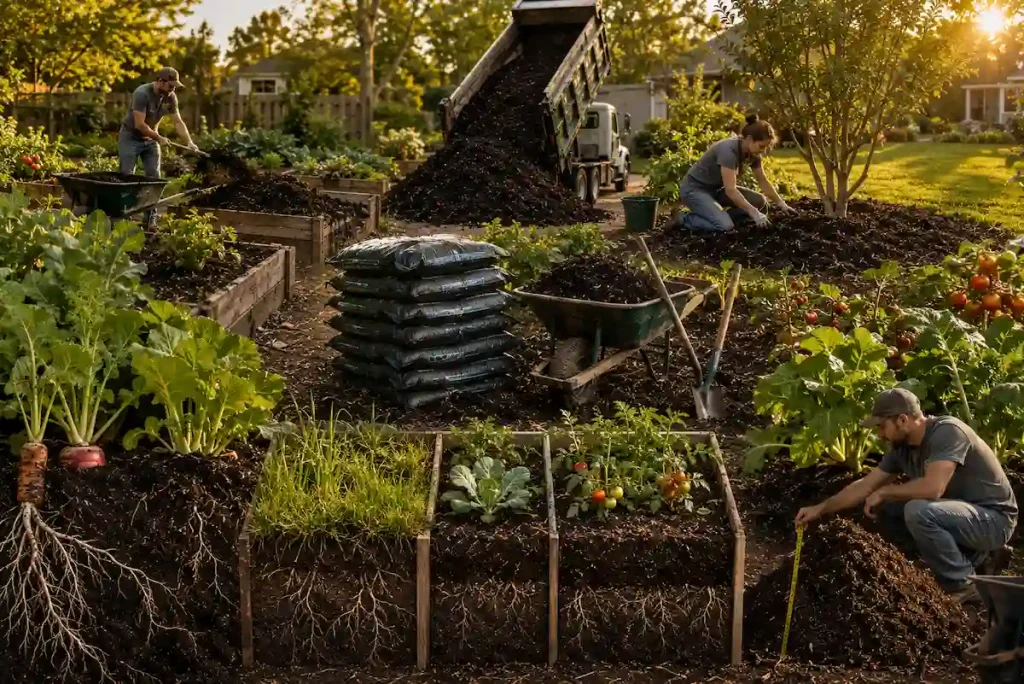
Buying compost sounds easy until you start calculating volume. Even a small garden bed can need far more material than most gardeners expect. Getting the amount right isn’t complicated — but you do need to match the depth to the job you’re doing. Quick answer: For most garden beds, apply 2–3 inches of compost per
Buying compost sounds easy until you start calculating volume. Even a small garden bed can need far more material than most gardeners expect. Getting the amount right isn’t complicated — but you do need to match the depth to the job you’re doing.
Quick answer: For most garden beds, apply 2–3 inches of compost per season. One cubic yard covers roughly 100 sq ft at 3 inches deep. For lawns, use ¼–½ inch maximum. New beds need 3–4 inches worked in; established beds need 1–2 inches annually.
How Much Compost Do I Need? 1 inch depth = 0.083 cu ft per sq ft 2 inches = 0.167 cu ft per sq ft 3 inches = 0.25 cu ft per sq ft 1 cubic yard covers ~100 sq ft at 3 inches
For most gardens, 2–3 inches of compost per year is enough to improve soil structure, organic matter, and moisture retention.
How much compost you need depends on garden size, soil condition, and compost depth. A lawn needs only a thin layer, while a brand-new raised bed can take several cubic feet. Below you’ll find exact compost coverage charts, bag estimates, cubic-yard conversions, and depth recommendations for every major garden use.
| Garden Size | Compost Needed at 2 Inches |
|---|---|
| 4×8 raised bed | ~5.3 cu ft |
| 10×10 garden | ~16.7 cu ft |
| 1000 sq ft lawn | ~83 cu ft |

The Quick Answer: Compost Coverage by Use Case
If you want a fast number without doing any math — here it is. Compost application depth varies depending on what you’re trying to achieve. General rule: 1–2 inches for maintenance, 3–4 inches when building new or heavily depleted soil.
| Use Case | Recommended Depth |
|---|---|
| Vegetable gardens | 2–3 inches |
| New beds | 3–4 inches |
| Lawns | ¼–½ inch |
| Established beds | 1–2 inches |
| Containers | 20–30% mix |

Vegetable Gardens
Apply 2–3 inches of compost worked into the top 6–8 inches of soil each season as part of your regular soil amendment routine. The best compost depth for vegetable gardens is usually 2–3 inches per season. For a 100 sq ft vegetable bed, that’s roughly 0.6–0.9 cubic yards (about 16–25 cubic feet). Most gardeners with a standard 10×10 bed need 2–3 large bags or a small bulk order each season.
Flower Beds and Borders
A 1–2 inch top-dress annually is usually enough for established flower beds. New beds need 3 inches worked in as a proper soil conditioning layer. For a 50 sq ft border, plan on 8–12 cubic feet — roughly 5–8 standard 1.5 cu ft bags.
Lawn Top-Dressing
Lawn compost applications are thin — typically ¼ to ½ inch maximum. Going heavier smothers grass. If you’re wondering how much compost for lawn top dressing, stick to a thin ¼–½ inch layer. For 1,000 sq ft of lawn, a ¼ inch compost layer needs about 0.77 cubic yards. Use finely screened compost only for lawns to ensure even coverage.
How Much Compost for Raised Beds? (New Fill vs Top-Up)

| Raised Bed Size | 2 Inches Compost | 3 Inches Compost |
|---|---|---|
| 4×4 | 2.7 cu ft | 4 cu ft |
| 4×8 | 5.3 cu ft | 8 cu ft |
| 4×12 | 8 cu ft | 12 cu ft |
A brand-new raised bed typically needs compost mixed at 30–40% of total volume. For a standard 4×8×12-inch bed (32 cubic feet total), you’d want 10–12 cubic feet of compost blended with topsoil and other amendments for healthy long-term soil structure. Many first-time raised-bed gardeners underestimate how quickly compost volume adds up.
Most gardeners are surprised by how quickly compost disappears once it’s mixed into existing soil. A compost for raised beds calculator helps estimate soil and compost volume before filling a new bed. A single 4×8 bed can easily use 10+ cubic feet once mixed properly. Annual top-ups are much lighter — 1 to 2 inches each spring is enough to replenish what breaks down.
Containers and Pots
In containers, compost should improve the potting mix — not replace it. Around 20–30% compost is usually enough for moisture retention and nutrients without suffocating roots. A standard 5-gallon container needs roughly 0.5–0.75 cubic feet of mix total, so about 1.5–2 cups of compost worked in.
Trees and Shrubs
Spread 1–3 inches in a ring extending out to the drip line — not piled against the trunk. A mature tree with a 10-foot drip radius needs around 2–3 cubic yards of compost for a proper mulch ring. For new plantings, mix compost at no more than 25–30% into the backfill soil.

This chart shows how many cubic yards and cubic feet of compost you need based on area and application depth. This chart helps estimate both cubic feet and cubic yard compost needs before buying. Use it to size your order before heading to the garden center or calling a bulk compost supplier.
How to Read the Chart
Find your garden area in the left column. Then match it to your target application depth. The number in each cell is the amount of compost needed — shown in both cubic feet and cubic yards. One cubic yard equals 27 cubic feet.
Coverage at 1 Inch, 2 Inches, 3 Inches, and 4 Inches
| Area (sq ft) | 1 inch depth | 2 inch depth | 3 inch depth | 4 inch depth |
|---|---|---|---|---|
| 25 sq ft | 2.1 cu ft / 0.08 cu yd | 4.2 cu ft / 0.16 cu yd | 6.3 cu ft / 0.23 cu yd | 8.3 cu ft / 0.31 cu yd |
| 50 sq ft | 4.2 cu ft / 0.16 cu yd | 8.3 cu ft / 0.31 cu yd | 12.5 cu ft / 0.46 cu yd | 16.7 cu ft / 0.62 cu yd |
| 100 sq ft | 8.3 cu ft / 0.31 cu yd | 16.7 cu ft / 0.62 cu yd | 25 cu ft / 0.93 cu yd | 33.3 cu ft / 1.23 cu yd |
| 200 sq ft | 16.7 cu ft / 0.62 cu yd | 33.3 cu ft / 1.23 cu yd | 50 cu ft / 1.85 cu yd | 66.7 cu ft / 2.47 cu yd |
| 500 sq ft | 41.7 cu ft / 1.54 cu yd | 83.3 cu ft / 3.09 cu yd | 125 cu ft / 4.63 cu yd | 166.7 cu ft / 6.17 cu yd |
| 1000 sq ft | 83.3 cu ft / 3.09 cu yd | 166.7 cu ft / 6.17 cu yd | 250 cu ft / 9.26 cu yd | 333.3 cu ft / 12.35 cu yd |
| 2000 sq ft | 166.7 cu ft / 6.17 cu yd | 333.3 cu ft / 12.35 cu yd | 500 cu ft / 18.52 cu yd | 666.7 cu ft / 24.69 cu yd |
How Many Bags Do You Need?
One of the most common questions gardeners ask is: how many bags of compost do I need for my garden size? Bagged compost comes in several sizes. The most common are 1 cubic foot, 1.5 cubic feet, 2 cubic feet, and 40-liter bags (roughly 1.4 cubic feet). To convert your cubic foot requirement into bags, divide by the bag size.
| Compost Needed | 1 cu ft bags | 1.5 cu ft bags | 2 cu ft bags | 40L bags (~1.4 cu ft) |
|---|---|---|---|---|
| 8 cu ft | 8 bags | 6 bags | 4 bags | 6 bags |
| 16 cu ft | 16 bags | 11 bags | 8 bags | 12 bags |
| 25 cu ft | 25 bags | 17 bags | 13 bags | 18 bags |
| 50 cu ft | 50 bags | 34 bags | 25 bags | 36 bags |
Many gardeners switch to bulk orders after realizing how quickly bag counts add up on larger beds.
Typical Compost Costs

- Bagged compost: $4–$10 per bag
- Bulk compost: $35–$80 per cubic yard
- Bulk usually becomes cheaper above 25–30 cubic feet
| Option | Best For | Main Advantage |
|---|---|---|
| Bagged compost | Small gardens | Easier handling |
| Bulk compost | Large gardens | Lower cost per cubic foot |
At 25+ cubic feet, bulk delivery almost always works out cheaper than bagged. Most suppliers deliver by the cubic yard — one yard covers 100 sq ft at a 3-inch compost spread rate. Bulk compost often settles during transport, so ordering 10–15% extra prevents coming up short.
How to Calculate Exactly How Much Compost You Need
To calculate compost needed: multiply Length (ft) × Width (ft) × Depth (ft). Convert depth to feet first — 2 inches = 0.167 ft, 3 inches = 0.25 ft, 4 inches = 0.33 ft. Divide the result by 27 to get cubic yards for bulk orders.
Compost Formula
Compost Needed (cu ft) = Length × Width × Depth Convert inches to feet before calculating.
Example: A 12×20 ft vegetable garden at 2-inch depth: 12 × 20 × 0.167 = 40 cubic feet (about 1.5 cubic yards)
For irregular shapes, break the area into rectangles, calculate each separately, then add them together. Most compost calculators switch between cubic feet and cubic yards depending on the project size. This cubic yard calculator approach works for any bed size or shape.
Converting Cubic Feet to Cubic Yards
Divide cubic feet by 27 to get cubic yards. Bulk suppliers always quote in cubic yards — so this conversion matters when ordering. 40 cubic feet ÷ 27 = 1.48 cubic yards. Round up slightly when ordering to account for settling and uneven spreading.
Compost Bag Sizes Explained (1 cu ft vs 1.5 vs 2 cu ft)
Bag labeling isn’t always consistent across brands and regions. Here’s what you’re actually getting:
- 1 cubic foot bag — smallest common size, good for small containers or spot amendments
- 1.5 cubic foot bag — most widely available in the US; a standard wheelbarrow holds about 3 of these
- 2 cubic foot bag — common in big-box stores; slightly better value per volume
- 40-liter bag — standard in the UK, Australia, and parts of Europe; equals roughly 1.4 cubic feet
If you want to skip the math entirely, our compost calculator does the full conversion for you — just enter your area and depth.
Why Compost Settles After Spreading (And Why You Need Extra)
Fresh compost settles faster than most gardeners expect. A bed that looks full on day one may lose 10–30% of its height after watering, microbial breakdown, and soil integration. This is one of the most overlooked factors when estimating how much organic matter to order.

| Compost Type | Expected Settling |
|---|---|
| Fine screened compost | 10–15% |
| Homemade compost | 15–25% |
| Woody compost blends | 20–30% |
| Raised-bed mixes | 15–20% |
If you’re ordering bulk compost for a new bed, order about 10–15% extra to compensate for settling. Need 2 cubic yards? Order 2.2–2.3 cubic yards instead. This is especially important for raised beds where a settled surface sits noticeably below the frame edge after the first season.
How Much Compost for New Beds vs Established Gardens
This is where a lot of gardeners go wrong. They apply the same amount of compost to a brand-new bed as they do to one that’s been amended for three seasons. The soil conditions are completely different, so the amount of compost needed changes too.
Building a New Bed From Scratch
Native soil — especially compacted clay or sandy, nutrient-poor ground — needs serious organic matter input upfront. For a new in-ground bed, work in 3–4 inches of compost across the full planting area and incorporate it into the top 8–10 inches. This builds the soil structure plants need before they ever go in the ground.
For a new raised bed, compost should make up 30–40% of your total fill mix. A typical 4×8×12-inch raised bed holds 32 cubic feet total — you’d blend in roughly 10–13 cubic feet of compost with topsoil, aged bark, or other amendments. Going above 50% compost in a new raised bed can cause nitrogen burn and drainage problems as the material continues breaking down.
Annual Top-Dressing for Existing Beds
Once your soil is in decent shape, maintenance dressings are much lighter. One to two inches applied each spring — or split between spring and fall — is enough to replenish what microbes and worms have broken down through the season. You don’t need to till it in every time either. Laying it on top and letting it work down naturally is fine for established beds, especially around perennials where root disturbance is a concern.
If your soil still compacts badly or drains poorly after a couple of seasons of amendments, bump up to 3 inches annually until structure improves. Healthy amended soil should feel loose and crumbly, hold moisture without waterlogging, and show active worm activity — signs that garden soil improvement is taking hold.
Does Compost Quality Change How Much You Need?
Yes — significantly. Two bags labeled “compost” at the same price and volume can perform very differently depending on what’s in them and how mature they are. Quality directly affects how much you need to apply to get results.
Mature vs Immature Compost
Fully mature compost is dark, earthy-smelling, and crumbles easily. It’s stable, won’t burn roots, and delivers nutrients in a form plants can use relatively quickly. Immature or partially composted material still has visible organic matter breaking down — it can temporarily tie up nitrogen in the soil as it decomposes, making nutrients less available to plants.
If you’re working with immature compost, apply it in fall rather than spring so it has time to finish breaking down before planting. You may also need to apply slightly more to get the same soil conditioning effect.
Homemade vs Bagged Compost
Good homemade compost made from a balanced mix of greens and browns, properly turned and fully finished, is often richer and more biologically active than most bagged products. You can typically get away with slightly less of it to achieve the same result.
Bagged compost quality varies a lot by brand. Some products are well-finished and nutrient-dense. Others are mostly aged wood chips or municipal green waste that’s more filler than amendment. Check the ingredient list — compost made from diverse organic inputs (food scraps, manure, plant material) generally outperforms single-source products. If you’re buying in bulk, ask your supplier what feedstocks went into the pile and whether it’s been tested.
Mistakes That Waste Compost (or Hurt Your Garden)

More isn’t always better with compost. These are the most common application errors — and they’re easy to avoid once you know what to look for.
| Mistake | What Happens |
|---|---|
| Too much compost | Salt buildup, drainage issues |
| Too little compost | Minimal soil improvement |
| Fresh compost before planting | Nitrogen tie-up |
| Thick lawn application | Grass smothering |
Applying Too Much
Piling on 6+ inches of compost annually is one of the more common mistakes, especially with gardeners who’ve read that “you can’t overdo compost.” You actually can. Heavy repeated applications can cause phosphorus buildup, excess salts, and drainage issues in raised beds. Some plants — particularly native species, Mediterranean herbs, and succulents — actively prefer lean soil and will struggle in heavily amended beds.
Stick to 1–3 inches per application depending on your use case. If your soil already has good structure and organic matter from previous seasons, a light 1-inch top-dress is often all it needs.
Plants That Hate Excess Compost
Not every plant wants rich soil. Over-applying compost can reduce flowering, weaken roots, or cause rot in certain plants.
| Plant Type | Compost Tolerance |
|---|---|
| Tomatoes | High |
| Squash | High |
| Native wildflowers | Low |
| Lavender | Very low |
| Rosemary | Very low |
| Succulents | Minimal |
| Carrots | Moderate |
| Peppers | Moderate |
Mediterranean herbs like rosemary, thyme, and lavender often grow worse in overly rich soil. Too much compost holds excess moisture and reduces root oxygen — exactly the opposite of what these plants need.
Applying Too Little
Scattering a thin half-inch layer across a depleted vegetable bed and expecting transformation is equally unrealistic. In badly depleted soil, one thin layer of compost usually isn’t enough to noticeably improve structure or drainage.
For soil improvement to actually happen, the organic matter needs to reach a threshold where microbial activity, structure change, and water retention noticeably shift. In genuinely poor soil, one thin application per year won’t move the needle much — you’ll need 2–3 inches minimum for at least two to three consecutive seasons.
Wrong Timing
Applying fresh or immature compost right before planting can temporarily tie up nitrogen and stress young seedlings. Spring application is best done 2–4 weeks before planting if using fresh homemade material. Bagged mature compost can go in right before or at planting time. Fall is the best window for heavy applications — it gives everything time to integrate over winter and the bed is ready to go come spring.
Seasonal Compost Application Guide
Timing your compost applications to the season makes a real difference — both in how plants respond and how efficiently the material breaks down into the soil.
Spring Application
Spring is the most popular time to apply compost, and for good reason — you’re feeding the soil right as plant growth accelerates. Apply 1–2 inches to established beds and work it lightly into the surface. For new beds, go 3–4 inches and incorporate it deeper. Wait until soil has warmed slightly and is no longer waterlogged before applying — working cold, saturated soil damages its structure.
Fall Application
Fall is arguably the better window for heavy amendments. Applying 2–3 inches after the last harvest gives the compost an entire winter to break down and integrate. Earthworms and soil microbes stay active well into autumn and will start working it in almost immediately. By spring, you’ll have noticeably improved soil without needing to wait or work around tender transplants.
Fall is also the right time to apply partially finished or homemade compost — the extra months of cold-weather breakdown mean it won’t cause nitrogen competition when you plant.
Mid-Season Top-Dress
A light mid-season top-dress — ½ to 1 inch applied around actively growing plants — works well as a slow nutrient boost and moisture retention layer. Keep it away from direct stem contact. This works especially well for heavy feeders like tomatoes, corn, and squash around 4–6 weeks after transplanting.
Compost Depth by Climate
Where you garden affects how much compost you need and when to apply it. Soil type and climate both influence the compost application rate that gets the best results.
- Hot southern climates: Lighter spring applications reduce moisture issues and prevent organic matter from burning off too quickly
- Cold northern climates: Heavier fall applications work well before winter — the freeze-thaw cycle helps incorporate the organic matter naturally
- Sandy soils: Slightly heavier compost additions help water retention and prevent nutrient leaching between waterings
- Clay soils: Repeated annual additions work better than one heavy application — steady organic matter input gradually breaks up compaction over multiple seasons
Before Ordering Bulk Compost: 5 Things Most Gardeners Forget

Bulk compost delivery saves money, but small planning mistakes can create major cleanup problems. One cubic yard weighs roughly 800–1,600 pounds depending on moisture content — that’s not a pile you want dropped in the wrong spot. One cubic yard looks much smaller in photos than it does dumped in a driveway.
1. Measure Access Width Many delivery trucks need at least 9–10 feet of clearance. Check your driveway or gate before booking.
2. Check Dump Location Wet compost is extremely heavy and can damage lawns or soft driveways. Have a firm, accessible surface ready — a tarp on pavers works well.
3. Cover Compost if Delayed Heavy rain can double moisture weight and make spreading much harder. Cover bulk piles with a tarp if you can’t spread immediately.
4. Use Compost Quickly Large piles heat up and compact if left sitting too long. Aim to spread within a few days of delivery for the best texture and workability.
5. Confirm Screened vs Unscreened Screened compost spreads more evenly in lawns and raised beds. Unscreened blends are better for building new beds where texture matters less.
How to Avoid Buying Too Much Compost
- Measure the area before ordering
- Account for settling separately — don’t fold it into your main estimate
- Don’t round up excessively on small beds
- Bulk orders usually need 10–15% extra, not 50%
- For small gardens, bags are often cheaper than delivery fees
FAQs about Compost Requirement for Your Garden
At 1 inch, you need 0.083 cubic feet per square foot. At 2 inches, 0.167 cu ft. At 3 inches, 0.25 cu ft. Multiply by your total area to get the full requirement.
2. How many bags of compost do I need for a 4×8 raised bed?
For a top-dress at 2 inches, you need about 5.3 cubic feet — roughly 3–4 standard 1.5 cu ft bags. For new fill at 30–40% compost, plan on 10–13 cubic feet, or 7–9 bags.
3. Can I use too much compost?
Yes. Over 3–4 inches annually in established beds causes phosphorus buildup, salt accumulation, and drainage problems. Some plants actively prefer lean soil — match the amount to your actual soil needs.
4. How much compost do I need for a vegetable garden?
For most vegetable gardens, apply 2–3 inches of compost yearly. A 10×10 garden needs about 16–25 cubic feet depending on depth — roughly 0.6–0.9 cubic yards in bulk.
5. Is it better to buy bagged compost or bulk?
Bags are practical under 1 cubic yard. Above 25–30 cubic feet, bulk compost delivery becomes noticeably cheaper per volume. If you’re amending 200+ sq ft, bulk is almost always the better choice.
6. How much does one cubic yard of compost cover?
One cubic yard covers 100 sq ft at 3 inches, 160 sq ft at 2 inches, or 324 sq ft at 1 inch. Use this as your baseline when sizing a bulk order.
7. How many cubic yards of compost do I need?
If you’re wondering how many cubic yards of compost you need, divide total cubic feet by 27. For example, a 500 sq ft bed at 2 inches needs 83 cu ft ÷ 27 = about 3.1 cubic yards.
8. When is the best time to apply compost?
Fall is best for heavy applications — compost integrates over winter and the bed is ready by spring. Spring works well for lighter top-dresses 2–4 weeks before planting. A mid-season ½–1 inch application gives heavy feeders a useful growth boost.
9. Does compost replace fertilizer?
Compost improves soil structure, water retention, and microbial activity, but it’s not a precise fertilizer substitute. Heavy feeders may still need targeted nutrients alongside compost. Use our fertilizer calculator to fine-tune inputs alongside your compost applications.
Final Thoughts: Compost Less Guesswork, More Growth
The biggest compost mistakes usually happen during planning — either buying far too little to improve the soil or applying far more than the garden actually needs. Get the depth right for your use case, time it to the season, and let the soil do the rest.
Use the coverage chart above to size your order before you buy. Apply 3–4 inches for new or depleted beds, 1–2 inches for annual maintenance, and ¼–½ inch for lawns. Don’t forget to account for settling — order 10–15% extra on bulk orders to stay ahead of it.
If you want to skip manual calculations entirely, our compost calculator handles area, depth, and unit conversions in one step. For planning a full kitchen garden layout alongside your soil prep, our vegetable garden layout planner is a useful companion tool.
Once your soil is amended and beds are set, our planting calendar by state and zone helps you time crops to your exact growing window. And if you’re managing irrigation alongside soil amendments, our plant watering calculator takes the guesswork out of moisture management once your beds are built.
For gardeners scaling up to larger plots or market growing, pairing compost planning with our fertilizer calculator gives you a complete picture of what your soil needs going into each season.
For scientific guidance on compost application rates and soil health, the University of Minnesota Extension composting guide provides research-backed application recommendations. The USDA Natural Resources Conservation Service soil health resource offers deeper context on organic matter’s role in long-term soil improvement.
















Leave a Comment
Your email address will not be published. Required fields are marked with *