Many farmers have looked over a weedy field and dreamed of what it could become with the right management. However, turning overgrown terrain into productive farmland takes more than effort — it demands planning and equipment built for reshaping the landscape efficiently. Today, modern farming technology and creative landscaping play a key role in transforming
Many farmers have looked over a weedy field and dreamed of what it could become with the right management. However, turning overgrown terrain into productive farmland takes more than effort — it demands planning and equipment built for reshaping the landscape efficiently.
Today, modern farming technology and creative landscaping play a key role in transforming difficult terrain into dependable growing space. With the right approach, land can produce excellent results over time through thoughtful preparation and grading. Let’s get into maximizing yields with advanced dozer technology.

Phase 1: Site Assessment and Analysis
The first and most crucial step is to understand what the land already offers. Land features appear similar at first glance, but small changes in slope and natural drainage can have a big effect on long-term productivity.
A survey of the land can show how water moves over the property following a rain event and where runoff tends to gather. Walking the site and noticing elevation changes and erosion patterns makes it easier to select where fields and irrigation lines should go. Even small slopes can be used to channel water to planting zones rather than letting it evaporate.
It is crucial to know what elements are already in place that could affect development plans. Seasonal washes or low-lying collection sites can be useful tools for irrigation planning from natural water sources. At the same time, rock outcroppings or dense overgrowth may affect where equipment can operate safely and where it should not be used for agriculture. Careful observation at this stage avoids costly modifications later and provides a better foundation for subsequent changes.
Phase 2: Strategic Planning and Due Diligence
The next phase is to turn observations into a strategy that works. Careful planning at this stage helps to minimize costly revisions later and ensures that equipment, infrastructure and planting areas are situated for long-term efficiency.
Through developing a land-use plan, farmers can determine where fields, access roads, equipment storage and buildings will be before any clearing takes place. A thoughtfully designed layout enhances workflow throughout the property and reduces wasted transit time between work zones. Even simple decisions like where to put a road can affect fuel use, soil compaction, and daily operating efficiency over time.
Another key step is soil testing. Representative soil sampling identifies nutrient levels, organic matter and pH balance so amendments can be applied where they will have the greatest impact. Soil testing allows for more precise fertilizer application and may improve nutrient efficiency and reduce unnecessary input costs, according to the United States Department of Agriculture (USDA).
Legal and environmental checks should also be done early in the planning phase. Local zoning restrictions, land-clearing permits and conservation criteria can affect where development is allowed and what equipment can be used on the property. If these needs are fulfilled in advance, the projects will continue to progress without any unforeseen delays during site preparation.
Before investing in any dozer, farmers should review how to choose the right machinery for your farm to ensure the equipment matches their specific soil conditions, terrain, and long-term operational needs.
Phase 3: The Initial Push: Clearing and Grubbing
Clearing and grubbing is the removal of surface barriers that interfere with the safe movement of equipment and the successful planting of crops. Addressing these barriers early lays a workable foundation for everything that follows, from irrigation arrangements to field preparation.
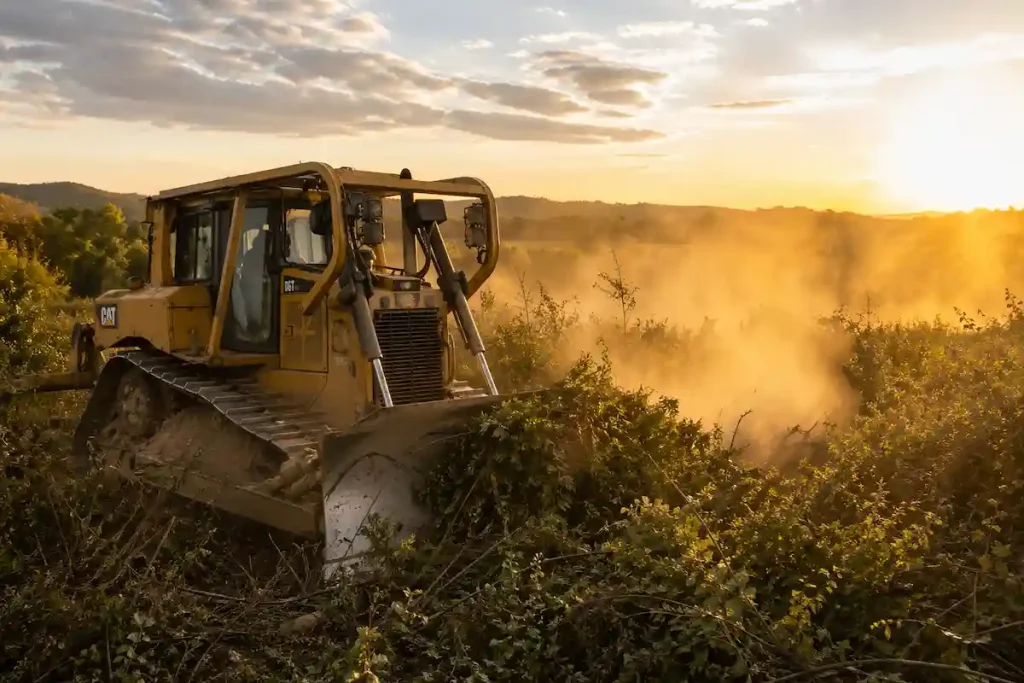
The initial job is usually to clear away the vegetation. Trees, stumps and dense brush can restrict access and impede grading work if left in place. A tracked vehicle like the Cat D5 dozer offers the traction and pushing strength needed to remove root systems and create access channels over unmanaged land. With about 170 horsepower available on these models, this class of equipment can handle heavy clearing work while remaining nimble enough for property-scale land development.
Next, is to move on to bigger barriers such as embedded rocks or compacted trash. Removing these obstructions enhances safety during subsequent equipment passes and reduces the risk of long-term damage to implements such as tillers or seeders. At this stage, clearing and grubbing can be completed so the project can proceed with grading, soil preparation and infrastructure placement without recurring interruptions later in the project.
Understanding the full range of farm machinery types, uses, and importance can help farmers select the right equipment for each stage of land clearing and site preparation.
Phase 4: Grading, Shaping, and Access
Now that the bulk material is removed, this phase is about shaping the soil into a usable surface that can accommodate planting and irrigation. A regular slope helps water circulate over the property and provides uniform growing conditions from one end of the field to the other.
A final grade helps distribute irrigation water more uniformly and removes spots where water can collect or run off too fast. Research has shown that land leveling enhances irrigation efficiency and crop output by producing regulated slopes that allow for more uniform distribution of water across the area. This approach makes it easy to control planting zones and maintain predictable moisture levels throughout the growing season.
Another critical stage is to build canals and drainage channels. Establishing small drainage channels can help move excess rainwater away from the planting area and prevent soil erosion. Studies on field leveling and irrigation performance also show that increased surface uniformity can boost grain yields by up to 24% through improved water coverage and crop establishment.

Phase 5: Debris Management and Site Cleanup
Once the clearing and grading work is done, the challenge shifts to dealing with the debris left by the site preparation. Good cleanup at this stage enhances safety across the entire property and prepares the field for planting and regular equipment movement.
Sorting and processing cleared items helps identify what can be reused and what needs to be removed from the site. Usable timber can be used for fending or erosion control, and smaller vegetation can be chipped for mulch to help retain soil moisture. Early separation of rock and organic waste also avoids interference with later field preparation activities such as tilling or sowing.
Disposal or reuse options can also help long-term soil quality and landscape stability. Where appropriate, some producers repurpose woody waste into soil-building features, such as hugelkultur beds or habitat piles along field edges. Where local restrictions allow, controlled fire procedures may also be utilized to reduce debris volume and prepare the site for the next stage of development.
Phase 6: Initial Soil Conditioning and Preparation
With the land cleaned and contoured, the next step is to prepare the soil itself for productive use. This phase is designed to improve structure and balance so that the ground can sustain consistent root development and predictable crop growth.
Heavy machinery has been utilized for clearing and grading, thus compaction is often the top priority. Passage of a ripper or subsoiler through compacted areas breaks up dense layers beneath the surface, allowing water and nutrients to travel more freely through the soil profile. Providing more air space in the soil at this point also assists root penetration when planting.
A first-pass amendment application follows based on earlier soil test findings. Gypsum and similar materials are often added to the soil to strengthen its structure before planting. Making these adjustments early creates a more stable growing environment and less need for frequent corrective treatments later in the developing process.
Phase 7: Implementing Long-Term Soil Health Strategies
This last phase is about preserving productivity over the long haul. Long-term soil health methods will help stabilize yields, cut input costs, and encourage more resilient planting conditions as the land continues to expand.
Introducing sustainable solutions at this point allows the gains accomplished in the prior phases to work in the background. Practices such as crop rotation, growing cover crops, and adding organic matter can progressively enhance soil structure and increase the soil’s ability to hold moisture. Over the long term, these methods lead to more even root growth and fewer repeat corrective treatments.
Many producers are shifting to farming practices that support biodiversity and increase soil health as part of this transformation. These regenerative practices aim to improve soil structure, boost biological activity, and enhance long-term water retention, enabling fields to remain productive year after year. This strategy helps ensure that newly created land continues to improve over time, rather than progressively losing fertility.
Selecting the Right Dozer for Farmland Development
The effectiveness with which ground may be cleared, contoured and prepared for planting can be greatly influenced by the correct dozer choice. Match the machine size, blade configuration and technology features to site conditions to help prevent unnecessary soil disturbance and ensure more uniform grading outcomes across the site.

Match Dozer Size to Terrain Conditions
You might think agriculture projects need massive production-class equipment. However, compact and midsize dozers frequently provide the optimal balance of mobility and pushing force when working around tree lines and smaller field layouts. On the other hand, bigger equipment is better for taking out stumps or reshaping uneven land over a larger area.
Choosing the right size first will ensure more efficient clearing work and that the soil structure remains protected throughout preparation.
Select the Right Blade Configuration
The way the blade is configured determines how efficiently material can be moved and worked during land preparation. Finish grading is done well with straight blades, and universal blades move larger volumes of soil during clearance. Semi-universal blades are great for agricultural operations, as they are frequently the most flexible for shaping and moving material.
The flexibility of these machines makes them particularly valuable in multistage farmland development initiatives.
Consider Ground Pressure and Soil Protection
Soil structure is important for long-term productivity. Wide-track or low-ground-pressure designs are very helpful in reducing compaction when operating on recently cleared ground. Early limiting compaction improves drainage performance and enables better root development at planting.
Evaluate Advanced Dozer Technology Features
Increasingly, manufacturers are equipping modern dozers with integrated grade control and slope-assist technologies and machine guidance displays to help operators hit consistent elevation targets while shaping fields. These techniques increase grading precision and reduce repetitive passes over the site, helping maintain soil condition throughout preparation.
Plan for Long-Term Versatility
Farmland development keeps going after the initial clearing stage. A dozer that can help maintain access paths and change planting zones over time can provide more long-term value than equipment chosen solely for initial site work.
Selecting a versatile machine can help ensure the equipment will be useful as that property continues to evolve.
Building a Strong Foundation for Long-Term Farm Productivity
Developing land for profitable farming requires planning, the right equipment and a smart approach to shaping and preparing the ground. Advanced dozer technology enables these early stages to be accomplished more effectively, improving drainage, soil conditions and field accessibility. With the correct prep strategy, farmers can put a better plan in place for consistent yields and long-term land performance.
















Leave a Comment
Your email address will not be published. Required fields are marked with *