Retailers small and large have urged the USDA and state agencies to improve communications to SNAP households. But they have not seen a hoped-for “robust education campaign,” Mannion said. Some states are providing signs to retailers that explain the changes, but retail organizations are also creating their own. “The message we want to get across
Retailers small and large have urged the USDA and state agencies to improve communications to SNAP households. But they have not seen a hoped-for “robust education campaign,” Mannion said. Some states are providing signs to retailers that explain the changes, but retail organizations are also creating their own.
“The message we want to get across is that this is not a retailer decision,” Mannion said. “This is government driven.”
Given the differences in how states define sugary beverages or candy, and the various exemptions for juice or dairy, retailers must now go through items individually to determine whether they fall under the restrictions. This process is time consuming and requires a lot of personnel, Mannion said. If an item does fall under the restriction, the store is also responsible for changing it in their system and updating shelf signage.
That all adds a cost, Mannion said, and it comes as retailers and the entire SNAP system are bracing for more policy changes, like proposed changes to SNAP retailer stocking requirements. In September, the USDA proposed a rule that would require SNAP retailers to increase the variety of foods from three to seven in each of the four staple food categories: animal protein, dairy, grains, fruits and vegetables.
Rollins recently suggested at an event celebrating the Dietary Guidelines that the final version of the rule could come in a matter of weeks.
“I think we’re concerned that this is just the tip of the iceberg,” Mannion said.
Potential Costs for All Consumers
The total up-front cost of the SNAP restrictions is projected to be $1 billion for convenience stores, $11.8 million for small-format stores and $215.5 million for supercenters, according to an analysis released by NACS, the National Grocers Association, and the Food Industry Association (FMI).
Some of these costs could be passed to consumers, the analysis says, which means the impact of these restrictions could reach beyond SNAP households.
“These SNAP restrictions are increasing food prices for everyone, and the high cost of healthy food is the No. 1 reason people on SNAP can’t eat healthier,” said Elzinga of the Des Moines Area Religious Council. “Banning items does not make healthy food more affordable.”
One of the “greatest fears,” Elzinga said, is that SNAP retailers will drop out of the program and stop accepting EBT. This could be because the costs of compliance are too high or because they get a second strike and are removed from the program.
In Iowa, one in three SNAP participants, more than 800,000 people, live in a border county. These shoppers could simply take their business to neighboring states that do not have SNAP restrictions. If all of those participants travelled out of state for their shopping, Iowa would lose about $23 million per month in economic activity, Elzinga said.
This is one issue states will be required to monitor and report on when evaluating the waivers.
Given their proximity to the West Virginia border, Adam and Beth Bedway can travel to Ohio or Pennsylvania to do their SNAP shopping, without restrictions.
“But there are lots of very poor places in this state that are right dead center in the middle of the state, where you’re four hours from the border,” Adam Bedway said. “We’re just very fortunate to have those options.”
Beth also pointed out that much of the state already struggles with access to clean water and fresh fruits and vegetables. In some parts of the state, the closest store for miles could be a Dollar General or a convenience store, which may not stock fresh options or could price them higher.
A Wave of Changes to SNAP
SNAP restrictions are taking effect alongside other major shifts in the food program. Last year, Republicans passed their One Big, Beautiful Bill (OBBB), which cut federal spending for SNAP by almost $187 billion through 2034.
Some of the policy changes included in the bill have already taken effect, like expanded work requirements. Other parts of the bill shift more costs of the program to the states, and those provisions are set to kick in next year.
In addition, Republicans in Congress have fixated on alleged fraud in the program, threatening to require that states recertify SNAP households and release more data on participants. Under the Trump administration, the USDA has focused on this, as well.
The changes in SNAP eligibility add to the workload of already overburdened SNAP case workers. And the impending cost-shifts to the states already have states considering how to absorb these in their budgets.
On top of this, it’s also not clear how states will fund implementation of the SNAP restrictions, Plata-Nino said.
Nebraska, for example, has estimated the state will spend $2 million on implementing the restrictions, Plata-Nino said, all while the state is facing a $471 million budget shortfall.
The USDA has historically been responsible for monitoring SNAP retailers. Typically, the only program where state agencies and SNAP retailers have a connection is through the Special Supplemental Nutrition Assistance Program for Women, Infants, and Children (WIC).
But these are very different programs, and have separate funding mechanisms to support state’s work and monitoring for WIC.
Nebraska has said it would use leftover funding through another program, SNAP-Ed, to cover the administration of its restriction after the federal SNAP-Ed program was cut in the OBBB. Plata-Nino said the waiver implementation funds won’t go toward outreach or explaining the new restrictions to SNAP households.

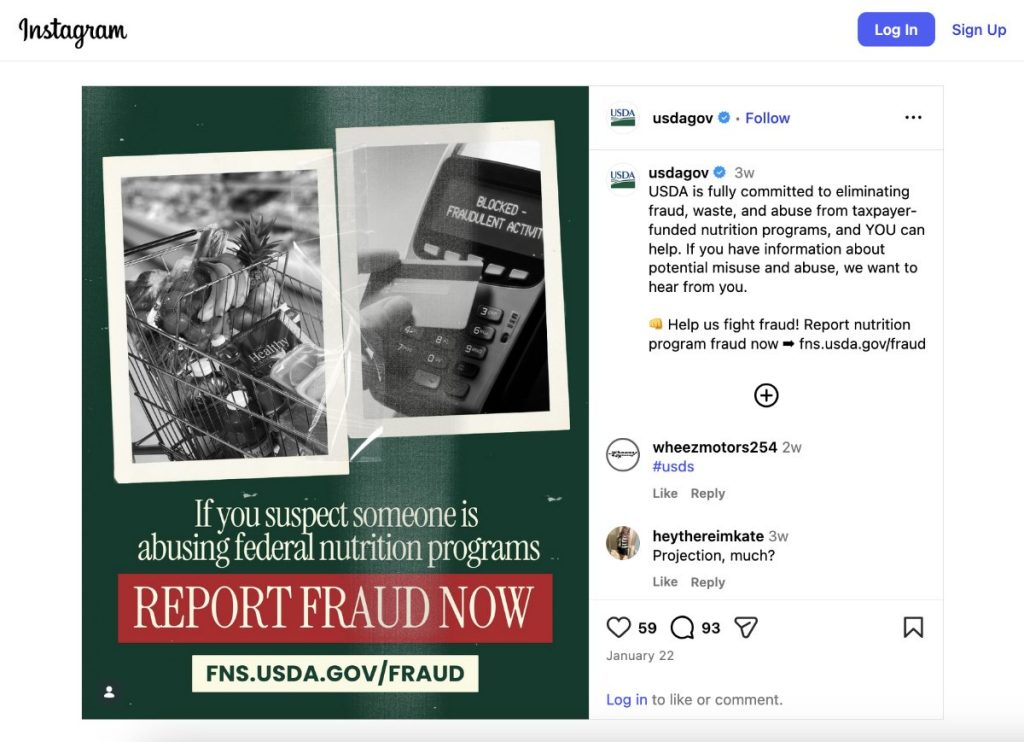
Experts worry that fraud allegations by federal officials could increase stigma around food aid and decrease participation. (Credit: USDA)
Higher Uncertainty, Lower Participation
In the midst of the USDA’s heightened focus on fraud, the agency took to social media to mobilize shoppers to help the agency “fight fraud.” “If you suspect someone is abusing federal nutrition programs, REPORT FRAUD NOW,” the post reads, paired with a photo of a full grocery cart. This rhetoric raises another concern with the overall changes to SNAP policy, which is the potential increased stigma around the program.
“When program stigma is higher, it has a dampening effect on participation,” Elzinga said.
Elzinga believes growing stigma around SNAP is already having an impact in Iowa. Food banks and pantries are continuously breaking records in terms of visits, he said, but SNAP enrollment is nearing an 18-year low. He worries the new restrictions will lead to fewer people participating in SNAP and more people turning to food pantries to feed their families.
“When program stigma is higher, it has a dampening effect on participation.”
The drop in enrollment could also be tied to federal and state policy shifts, like previous changes to work requirements. But Elzinga said negative narratives around the program likely have an effect.
Despite the concerns from retailers, SNAP recipients, and anti-hunger groups, during a speech on Jan. 13, less than two weeks after the restrictions kicked in, Iowa Governor Kim Reynolds, a Republican, called on the state legislature to keep the federal waiver “moving forward.”
Three more states, Kansas, Mississippi, and Ohio, have also submitted waivers for USDA approval. Some of the states that have already approved waivers are also talking about expanding the list of restricted foods, Plata-Nino said.
As states legislatures return to session, several will consider legislation to request their own SNAP food restriction waiver.
In West Virginia, facing all the changes to the program her family has relied on for nearly a decade, Beth said she’s “waiting for the other shoe to drop.”
“It’s unsettling,” she said. “It makes me question what is the future for us in this state, what is the future for the SNAP program? At what point are we just going to be kicked off of any assistance without warning?”












Leave a Comment
Your email address will not be published. Required fields are marked with *